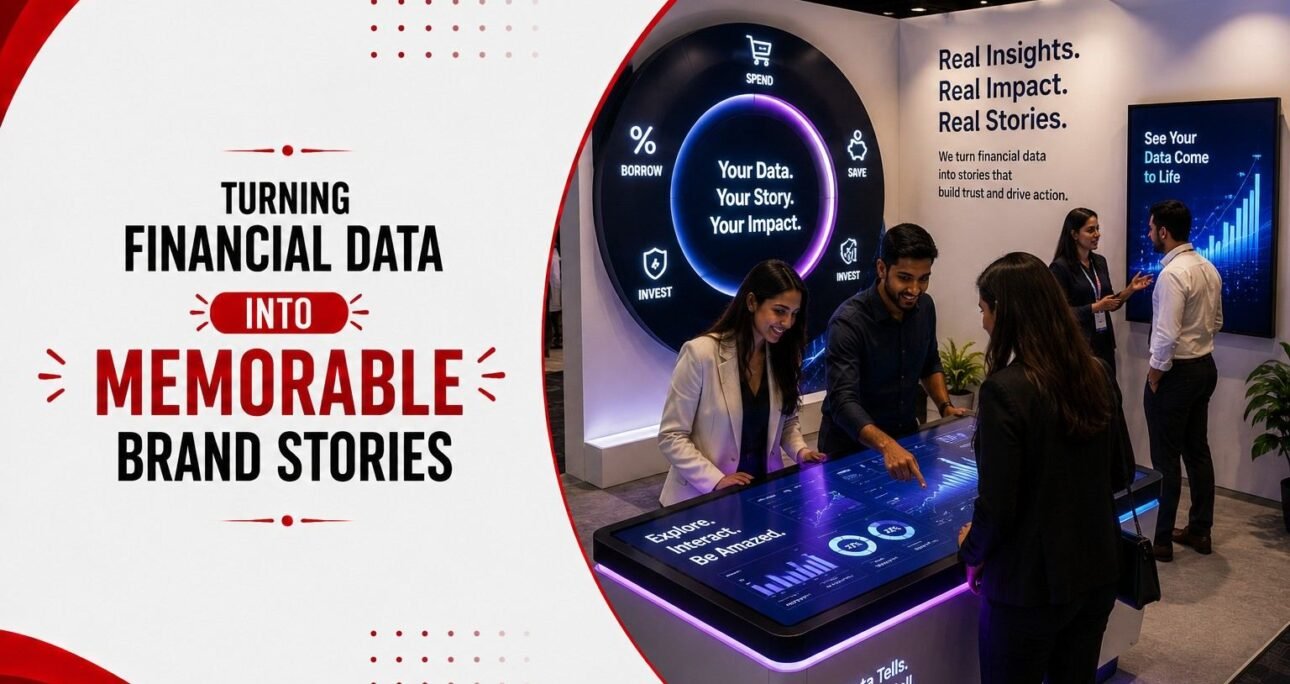
Financial brands have no shortage of numbers to talk about. Transaction volumes, customer growth, investment figures, product features and performance metrics can all tell an important story. The problem is that numbers alone rarely make people stop, listen or remember. This is where fintech experiential marketing comes in. Instead of simply presenting financial information, brands can turn it into something people can see, explore and interact with. A complex product can become a live demonstration. A statistic can become an interactive visual. A financial journey can become an experience that visitors actually take part in. For fintech companies, this shift matters because financial products can often feel technical or difficult to differentiate. A well-designed experience gives people a simpler way to understand what a brand does and why it matters. The idea is simple: data informs, stories explain, and experiences make people remember. In this article, we look at how fintech brands can turn financial data into meaningful brand stories and then take those stories beyond screens into exhibitions, conferences, product launches and interactive brand activations.
What Is Fintech Experiential Marketing?
Fintech experiential marketing is the use of interactive, live or immersive brand experiences to help financial technology companies communicate their products, services and data in a way that people can understand, engage with and remember. It can include exhibitions, conferences, product launches, interactive installations, demonstrations and brand activations. Unlike traditional marketing, where people may see an advertisement, read about a product or visit a website, experiential marketing gives them an opportunity to experience the brand. They might explore an interactive financial dashboard, test a product through a simulation or take part in a personalised activity. For fintech brands, this is particularly useful when the product is technical or difficult to explain in a few words. Instead of asking visitors to understand a complicated product description, the experience can show them how the product works and what problem it solves. The goal isn’t to add technology simply for the sake of making an experience look impressive. The technology, design and storytelling should all work together to make the brand’s message clearer and more meaningful.
Why Storytelling Matters in Fintech Marketing
Financial products can be difficult to explain because they often involve technical features, numbers and processes that aren’t immediately easy to understand. A list of features may tell people what a fintech product does, but it doesn’t always explain why they should care about it. Storytelling helps bridge that gap. Instead of presenting a product through statistics alone, brands can build a simple narrative around a problem, the people facing it and how the product helps solve it. A payment platform, for example, isn’t only about transaction speed or processing volume. Its story could be about helping a business accept payments more easily and spend less time dealing with payment issues. This makes the information easier to relate to and remember. It also gives financial data a purpose rather than presenting it as a collection of impressive numbers. For fintech brands, effective storytelling should answer three basic questions:
- What is the problem?
- How does the brand solve it?
- What changes for the customer?
But a good story doesn’t have to remain on a screen or inside a presentation. When that story is brought into an exhibition booth, conference, product launch or brand activation, people can move from simply hearing the story to experiencing it. That is where fintech storytelling starts becoming experiential marketing.
Why Financial Data Alone Isn’t Enough
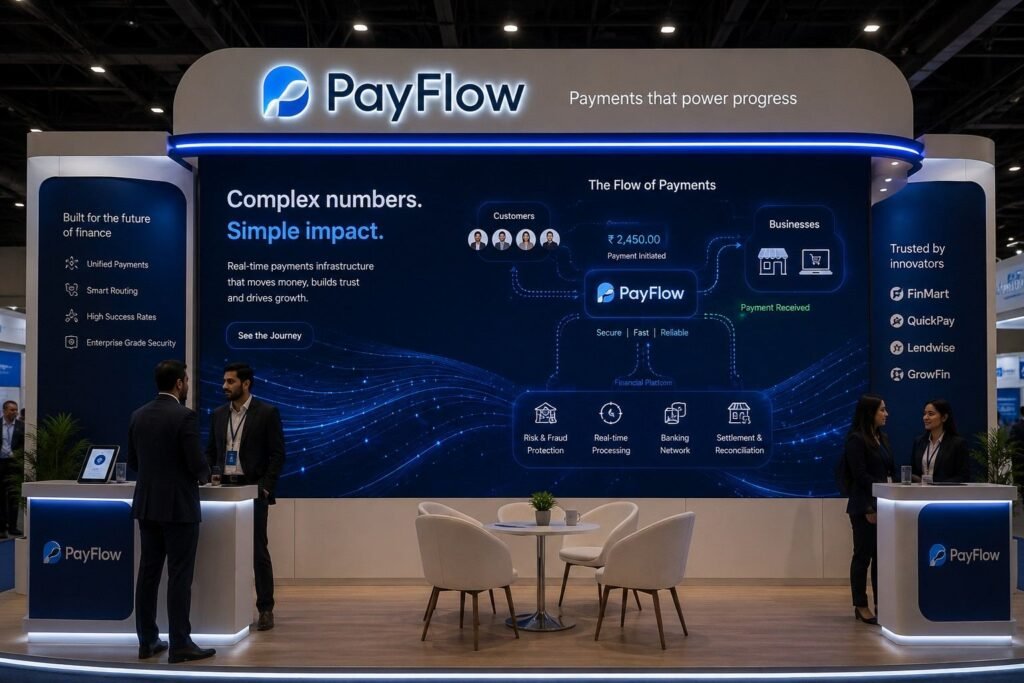
Financial data can prove that a business is growing, a product is being used or a service is making an impact. But data on its own doesn’t always give people a reason to care. Imagine an exhibition booth displaying a large number showing how many transactions a fintech platform has processed. It may look impressive, but a visitor can still walk past without understanding what that number means. Now imagine that same data being turned into a live visual showing how those transactions helped businesses receive payments faster, manage their cash flow or serve more customers. The number now has context. It tells a story.
This is the difference between displaying information and creating understanding. For fintech brands, the most effective experiences don’t hide the data. They give it meaning. A statistic can become a visual journey, a product feature can become an interactive demonstration, and a customer outcome can become the central part of the experience. When financial data is presented this way, visitors have something more than information to look at. They have a reason to stop, explore and engage with the brand.
How Can Fintech Brands Turn Financial Data Into Experiences?
Turning financial data into an experience doesn’t mean putting more numbers on bigger screens. The real challenge is deciding what the data should communicate and how people should interact with it. A useful approach is to move from information to meaning, and then from meaning to interaction. At a fintech exhibition, for example, instead of displaying a dashboard filled with transaction figures, a brand could turn those figures into a live visual showing how payments move between businesses and customers. The visitor doesn’t just see the data; they understand what it represents. Here are a few ways fintech brands can make that happen.
Visualise the Data
Large datasets can be difficult to understand when presented as tables or long reports. Visual elements such as animated graphics, interactive dashboards, data walls and LED displays can make patterns and trends easier to grasp. For example, a payments company could create a live data wall showing transaction activity across different markets. As the numbers change, the visualisation could highlight important trends rather than forcing visitors to read a spreadsheet on a screen. The key is to highlight the insight, not display everything. Visitors should understand the main point within a few seconds.
Connect Numbers to Human Stories
A financial figure becomes more meaningful when people understand its real-world impact. Imagine a fintech brand showing that its platform has processed millions of transactions. Instead of stopping at that number, the experience could follow the journey of a small business receiving a payment, managing its cash flow and serving its customers. The number provides proof, but the human situation gives it meaning. This is what turns financial data into a story people can relate to.
Make the Experience Interactive
People are more likely to engage when they can do something rather than simply watch. An interactive touchscreen at a fintech booth could let visitors adjust different financial scenarios and see how the outcome changes. A lending platform, for example, could use a simplified simulation to show how different factors affect a business’s financing journey. The interaction doesn’t have to be complicated. Even a simple calculator, product explorer or choose-your-own-journey experience can make the information more engaging.
Demonstrate the Product
Some fintech products are much easier to understand when people can see them in action. A live demonstration can take visitors through a realistic customer journey from making a payment to receiving confirmation, or from starting an application to completing the process. Instead of explaining every feature verbally, the brand can let visitors see how the product works and ask questions as they go. This can make a technical product feel much more approachable.
Give Visitors a Personal Journey
Personalisation can make an experience feel more relevant. A visitor might answer a few questions, explore a financial scenario or receive information based on their interests. For example, an investment platform could create an interactive experience where visitors select a hypothetical financial goal and explore different investment approaches. The purpose isn’t to give generic advice, but to demonstrate how the platform helps users make informed decisions. The objective isn’t to collect information simply because technology makes it possible. It is to give visitors a reason to participate and leave with a clearer understanding of the brand. When these elements come together, financial data stops being something people simply look at. It becomes part of a story they can see, explore and experience.
The DATA-to-EXPERIENCE Framework for Fintech Brands
A good fintech experience doesn’t begin with a decision about using a giant LED screen, touchscreen or the latest technology. It begins with a much simpler question: What do we want people to understand and remember? Fintech brands already have plenty of information to work with. The challenge is deciding what is worth showing and finding a way to make it meaningful to the people standing in front of it. The DATA-to-EXPERIENCE framework helps with that process. It takes useful information and turns it into a story that people can see, understand and take part in.
D – Discover the Data
Start with the numbers, but don’t start by showing all of them. A fintech company might have figures on transactions, customers, processing time, growth or product usage. That doesn’t mean an event visitor needs to see all of them. Instead, ask: Which number or insight actually says something important about our brand? For example, a payment company may have processed millions of transactions. That’s a strong figure, but simply putting the number on a screen doesn’t tell visitors much. The brand could instead focus on what that number represents: businesses accepting payments, customers completing purchases or the scale of the payment network. The number is still there. It just has a purpose. Before moving ahead, ask:
- Is this data relevant to the audience?
- Does it support the product story?
- Can visitors understand why it matters?
- Is there a simpler way to communicate it?
If the answer to these questions is yes, you have something worth building an experience around.
A – Add Human Context
Numbers become easier to understand when there is a real situation behind them. Consider a fintech lending platform. Saying that the company has provided thousands of loans is useful, but it doesn’t tell the whole story. Instead, the experience could show what happens behind one of those loans: A business needs funding → applies for finance → receives approval → gets access to funds → uses them to grow. Suddenly, the data has a story attached to it. The same approach can work for other fintech products. A payment platform can show the journey of a transaction from customer payment to merchant confirmation. An investment platform can show how someone might move from a financial goal to exploring different investment options. The idea isn’t to make everything emotional. It is simply about giving people some context. Instead of asking visitors to remember a statistic, give them a reason to understand it.
T – Transform the Story
Once the story is clear, think about how people should experience it. This is where the creative idea comes in. A financial insight could become an animated data wall, an interactive dashboard, a product simulation, a digital journey or even a physical installation. The right format depends on the message and where the experience will take place. For example, at a fintech exhibition, a brand could create an interactive payment journey. A visitor selects a type of transaction and follows what happens at each stage. Rather than reading a product brochure, they see the process unfold in front of them. Another brand might use a large interactive display to show how its platform connects businesses and customers across different locations. The technology helps bring the story to life, but it shouldn’t take over the story. If visitors remember the screen but forget the brand, the experience has missed the point.
A – Activate the Audience
Now give visitors something to do. This can be as simple as exploring a product, making a selection, testing a simulation or answering a few questions. The experience doesn’t have to be complicated to be engaging. For example, a fintech brand could allow visitors to enter a hypothetical business situation and explore how its product could help. An investment platform could let people choose a financial goal and explore different scenarios through an interactive demonstration. The important part is that the visitor is involved. They aren’t just standing in front of a screen while someone explains the product. They are making choices, exploring information and discovering how the solution works. That makes the experience feel more personal and gives the brand team a natural starting point for a conversation.
What Does This Look Like in Practice?
Imagine a fintech company wants to showcase the scale of its payment network at an industry exhibition. Instead of putting its transaction numbers on a wall, the brand could build the experience step by step:
- Discover the Data: Identify transaction volume as the strongest story.
- Add Human Context: Show what those transactions mean for businesses and customers.
- Transform the Story: Turn the payment journey into an interactive visual.
- Activate the Audience: Let visitors explore different payment scenarios themselves.
The end result is more than a collection of statistics. The visitor gets to understand what the company does, why it matters and how the product works.
Fintech Experiential Marketing Ideas

The best fintech experiences don’t rely on technology alone. They start with a clear message and give visitors a reason to interact with it. The experience could be as simple as a product demonstration or as immersive as a room-sized data installation. What matters is whether it helps people understand the brand. Here are some practical ways fintech companies can turn their products, data and stories into experiences.
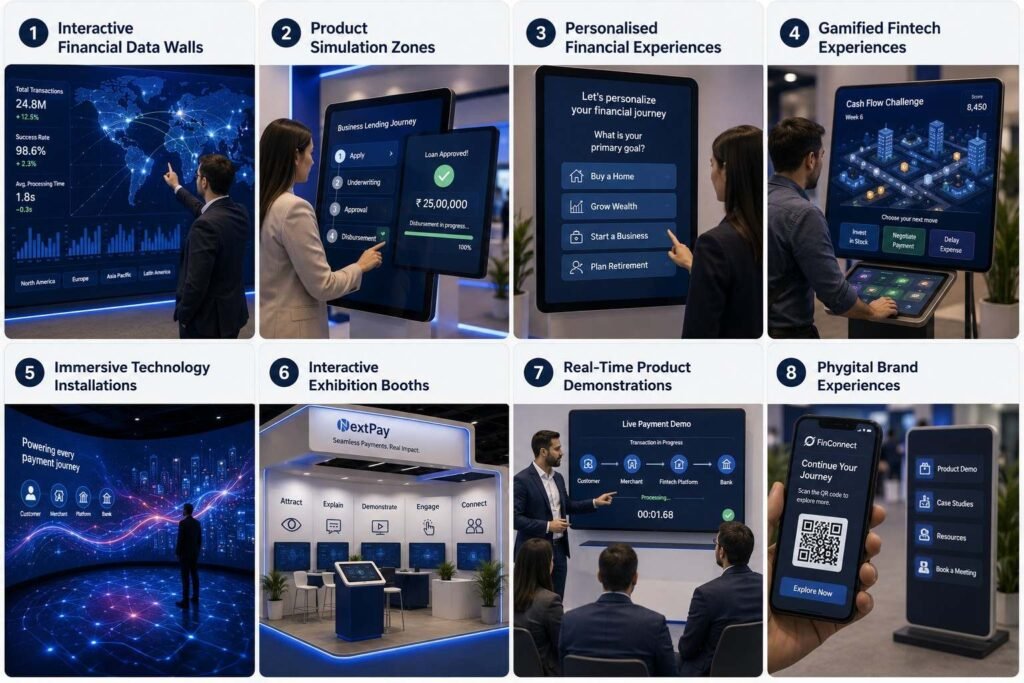
1. Interactive Financial Data Walls
Instead of displaying static numbers, turn important financial data into a visual experience that changes as visitors interact with it. A payment company, for example, could show how transactions move across different markets or how quickly payments are processed. Visitors could select a region, transaction type or business category and see the information change on screen. This works particularly well at exhibitions and conferences because the movement can catch attention from a distance, while the interaction gives people a reason to stay.
2. Product Simulation Zones
Some fintech products are difficult to explain through brochures or presentations. A simulation can let visitors experience a typical customer journey and see how the product solves a problem. A lending platform could create a simplified business funding journey, taking visitors from an application through to approval and disbursement. A payment company could demonstrate what happens during an online transaction. The visitor doesn’t have to understand every technical detail. They simply get to see the product working in a situation that feels familiar.
3. Personalised Financial Experiences
Personalisation can make an event interaction feel less like a sales pitch and more like something created for the individual. A fintech brand could ask visitors a few simple questions and then guide them towards a relevant product feature, financial scenario or interactive demonstration. A wealth-tech company, for instance, could create a hypothetical goal-based journey where visitors choose a goal and explore how different financial decisions could affect it. The experience should provide something useful to the visitor rather than collecting personal information without a clear purpose.
4. Gamified Fintech Experiences
Financial concepts don’t always have to be serious or complicated. A simple game can make an unfamiliar product easier to understand while encouraging people to spend more time with the brand. A fintech company could create a decision-based game where visitors manage a fictional business, make payment or cash-flow decisions and see the consequences of their choices. The game doesn’t need complicated rules. In fact, the simpler it is, the easier it may be for someone walking through a busy event to participate. The important part is keeping the game connected to the product. If visitors remember the game but cannot explain what the fintech brand does, the experience hasn’t done its job.
5. Immersive Technology Installations
LED environments, projection mapping, augmented reality and other technologies can help turn abstract financial concepts into something people can see around them. Imagine an installation that takes visitors through the journey of money moving between a customer, merchant and financial platform. Instead of reading about the process, they experience it through visuals, movement and sound. These installations can create strong first impressions, particularly at large conferences and exhibitions. But technology should always have a purpose. A visually impressive setup is useful only when it helps people understand or remember the brand.
6. Interactive Exhibition Booths
A fintech exhibition booth can bring several of these ideas together. Rather than covering every wall with product information, the space can have distinct areas for attracting attention, explaining the product, demonstrating it and continuing the conversation. For example: Attract → Explain → Demonstrate → Engage → Connect. Someone passing the booth sees the main message. A visitor who stops can explore the experience. A genuinely interested prospect can then speak with the team or move into a meeting area. This makes the booth part of the marketing strategy rather than simply a branded space at an event.
7. Real-Time Product Demonstrations
When a product can be demonstrated live, use that opportunity. A fintech company could show how quickly a payment is processed, how a dashboard works or how a business can use a platform to manage transactions. A presenter can explain what is happening while visitors watch or participate. Live demonstrations also create natural opportunities for questions. Instead of a one-way presentation, the interaction becomes a conversation between the brand and its audience.
8. Phygital Brand Experiences
Not every fintech experience needs to end when the visitor leaves the event. A physical interaction can be connected to a digital journey through QR codes, mobile experiences, personalised content or follow-up resources. For example, someone could explore a product at a booth, scan a QR code to continue the demonstration on their phone and then request a meeting with the brand team. This creates a bridge between the physical event and the digital experience. It also means the event doesn’t have to carry the entire customer journey on its own. The physical experience creates the initial connection, while digital touchpoints can help continue the conversation afterwards.
How Can Fintech Brands Use Experiential Marketing at Events?
Events give fintech brands something a website or advertisement cannot always provide: direct interaction with the audience. A visitor can ask a question, try a product, speak to the team and understand the brand in one experience. The challenge is making that interaction intentional.
Fintech Exhibitions
At an exhibition, the experience has to work quickly. A visitor may pass a booth without knowing anything about the brand, so the design should communicate the main idea almost immediately. Interactive displays, product demonstrations and simple data visualisations can give people a reason to stop. Once they engage, the experience can take them deeper into the product story.
Fintech Conferences
Conferences bring together decision-makers, industry professionals and potential partners. Here, the experience can focus less on attracting large crowds and more on meaningful conversations. A well-designed experience might combine product demonstrations, thought-leadership content, interactive technology and spaces where visitors can have focused discussions with the brand team.
Product Launches
A fintech product launch is an opportunity to let people experience the product rather than simply hear an announcement. A launch can use demonstrations, interactive screens, guided product journeys or immersive storytelling to show what has changed and why the product matters.
Brand Activations
Brand activations can take fintech beyond traditional event spaces. Interactive installations, financial challenges, personalised experiences or technology-led activities can help brands introduce themselves to new audiences in a more memorable way.
Customer and Corporate Events
For existing customers and business partners, the focus can shift towards trust, education and relationship building. Product updates, customer success stories and interactive demonstrations can be brought together to create a more engaging experience. Across all these formats, the visitor journey should remain clear: Notice → Understand → Interact → Trust → Act. The objective isn’t simply to make people stop at an event. It is to give them enough value and context to make the next interaction with the brand feel natural.
How to Design a Fintech Exhibition Experience That Converts
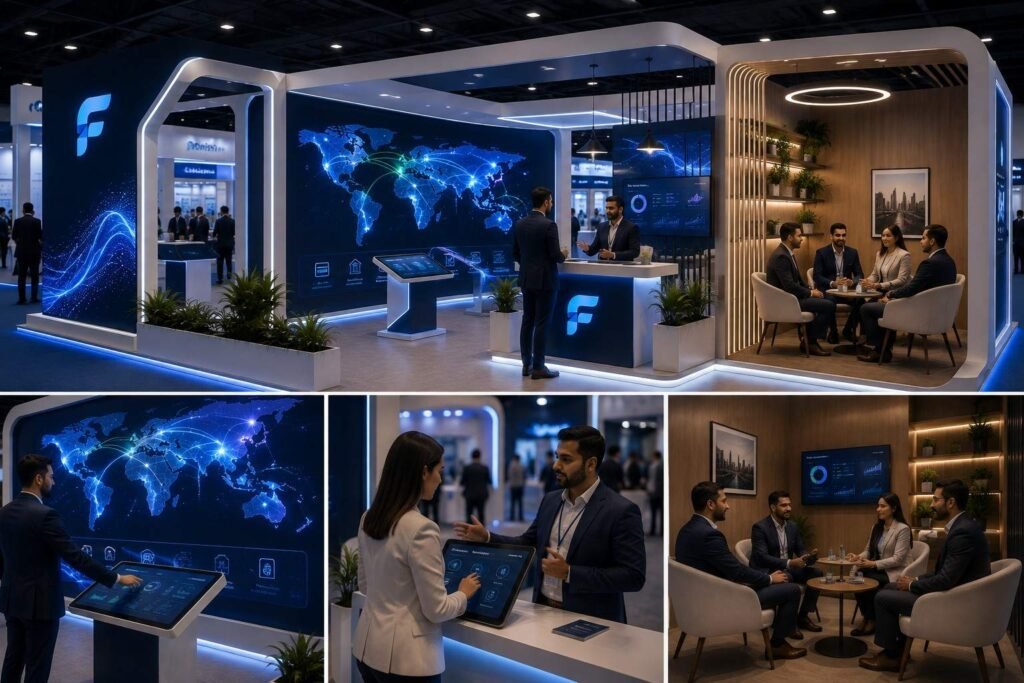
A fintech exhibition booth has a small window to make an impression. Visitors may see dozens of brands during an event, so simply displaying a logo, product features and large screens is rarely enough. The booth needs to tell a clear story and give visitors an easy reason to engage.
- Start With the First Impression: The main message should be visible from a distance. Strong branding, clear visuals and one focused message can help visitors understand what the company does before they even enter the booth.
- Make the Product Easy to Understand: Once someone stops, the experience should quickly answer: What does this product do, and why does it matter?. An interactive demonstration or simple visual journey can often communicate this better than several panels of text.
- Give Visitors Something to Do: Interaction creates a natural opportunity for conversation. Visitors could explore a dashboard, test a product simulation, complete a financial challenge or compare different scenarios. The activity should always have a purpose and connect back to the brand.
- Create Space for Real Conversations: Not every interaction needs to happen in front of a screen. A comfortable meeting area allows sales teams to understand the visitor’s needs and continue the conversation in more detail.
Build in the Next Step
A successful experience shouldn’t end when the visitor walks away. A product demo, meeting request, QR journey or follow-up mechanism can help turn event engagement into a business opportunity. The strongest fintech exhibition experiences therefore follow a simple path: Attract attention → Explain the value → Encourage interaction → Build trust → Create an opportunity. A visually impressive booth may win attention, but a well-planned visitor journey is what gives that attention a chance to become meaningful engagement and, eventually, a lead.
Common Fintech Experiential Marketing Mistakes
A fintech experience can have impressive technology, strong visuals and a large footprint and still fail to connect with visitors. The problem is often not the execution itself, but the thinking behind it. A good experience should make the brand easier to understand, not make the audience work harder to understand it. Here are some common mistakes fintech brands should watch out for and what they can do instead.
Showing Too Much Data
More information doesn’t necessarily mean better communication. A booth filled with numbers, charts, product features and statistics can quickly become overwhelming, especially when visitors are moving through a busy exhibition.
How to avoid it: Choose the few insights that actually support the main message. Use visuals to simplify them and keep deeper information available for visitors who want to explore further.
Making Technology the Main Attraction
Interactive screens, AR, VR and immersive displays can attract attention, but technology should support the brand story rather than become the story. If visitors leave talking about how impressive the screen was but cannot explain what the fintech company actually offers, the technology has taken over the experience.
How to avoid it: Decide on the message and visitor journey first. Then choose the technology that helps communicate it. The creative idea should come before the equipment.
Creating Spectacle Without a Message
An impressive installation may bring people over, but curiosity alone doesn’t create a meaningful brand experience. A large interactive display might attract a crowd, but if visitors don’t understand what they are supposed to learn or do, the attention may not lead anywhere.
How to avoid it: Give every major element a clear purpose. Ask what the visitor should understand after interacting with it and how that interaction connects back to the product or brand.
Ignoring the Visitor Journey
A visitor shouldn’t have to figure out what to do next. If the entrance is blocked, the main message is unclear or the product demonstration is hidden somewhere at the back, even a well-designed booth can lose potential engagement.
How to avoid it: Plan the experience from the visitor’s point of view. Think about what they see first, where they go next, what they interact with and where the conversation eventually happens.
Forgetting the Next Action
An experience that ends with a visitor walking away has missed an opportunity. Someone may spend five minutes exploring a product but have no obvious way to continue the conversation afterwards.
How to avoid it: Build the next step into the experience. This could be a product demo, meeting request, QR journey, consultation or follow-up resource. It should feel like a natural continuation rather than an aggressive sales push.
Focusing on Technology Instead of People
It’s easy to design an experience around screens and forget about the people standing around them. A visitor may have a question that no interface can answer, or they may be ready for a conversation after completing a demonstration.
How to avoid it: Treat technology and people as parts of the same experience. Train event staff to understand the interactive elements and step in when a visitor needs more information.
Forgetting That Fintech Is a Trust-Driven Category
Financial products involve sensitive decisions, so an experience that looks impressive but communicates unclear or exaggerated claims can work against the brand.
How to avoid it: Keep product information accurate, easy to understand and responsibly presented. Financial claims and customer-facing communication should be reviewed appropriately and aligned with applicable requirements.
How Do You Measure Fintech Experiential Marketing ROI?
Measuring the success of a fintech experience goes beyond counting how many people visited a booth or attended an event. The more useful question is what those interactions led to. A brand can look at a combination of engagement, lead and business metrics to understand whether the experience achieved its purpose.
Metric | What It Measures |
Visitors | Overall reach |
Dwell time | Level of interest |
Interactions | Audience engagement |
Product demos | Product interest |
Qualified leads | Business opportunities |
Meetings | Sales intent |
Conversions | Commercial impact |
For example, a booth that attracts 2,000 visitors may appear successful at first. But if only a handful of visitors engage with the product or become qualified leads, the overall impact may be limited. On the other hand, a smaller experience that attracts fewer but highly relevant decision-makers could generate more valuable conversations and opportunities. Fintech experiential marketing ROI should therefore be measured through both experience and business outcomes, including engagement, qualified leads, meetings, conversions and post-event opportunities. The right metrics will depend on the objective of the campaign. A product launch may focus on awareness and demonstrations, while a B2B fintech exhibition may place greater importance on qualified leads and meetings.
Fintech Storytelling vs Fintech Experiential Marketing
Fintech storytelling and experiential marketing are closely related, but they serve different purposes. Storytelling helps a brand explain its product, purpose or impact. Experiential marketing takes that message into the real world and gives people a chance to interact with it. This difference becomes important when a fintech product is technical or difficult to explain. A good story can make the idea easier to understand, while an experience can help visitors see how that idea works in practice.
Fintech Storytelling | Fintech Experiential Marketing |
Focuses on communicating a message | Focuses on creating an interaction |
Audience mainly reads, watches or listens | Audience participates in the experience |
Useful for explaining the brand or product | Useful for demonstrating the product |
Data is usually presented through content or visuals | Data can become interactive |
Interaction may be limited | Interaction is usually part of the experience |
Can build awareness and understanding | Can support engagement and lead generation |
Examples include videos, articles and presentations | Examples include booths, activations and product demonstrations |
Storytelling Helps People Understand the Product
Financial products often come with their own language. Terms, processes and numbers can make sense to people working in the industry but may not be immediately clear to everyone else. Storytelling helps simplify that information. For example, a fintech company offering a payment solution could talk about the problems businesses face with payment collection, reconciliation or delayed settlements. Instead of starting with a list of technical features, the brand can first explain the situation and then introduce its product as the solution. The data and product features are still important. They simply have a clearer context. This is why storytelling works well across websites, videos, presentations, social media, case studies and other forms of content. It gives people a reason to understand the product before asking them to consider it.
Experiential Marketing Makes the Story Tangible
The same idea can be taken further at an exhibition or conference. Suppose that a payment company is exhibiting at a fintech event. Rather than explaining the payment process through a presentation alone, the brand could create an interactive demonstration showing what happens from the moment a customer makes a payment to the point when the merchant receives confirmation. Visitors can follow the process, ask questions and see the product in action. The story hasn’t changed. The way people experience it has. This is where experiential marketing becomes particularly useful for fintech brands. It gives people an opportunity to move beyond simply hearing about a product and actually explore how it works.
They Work Better Together
There is no need for a fintech brand to choose between storytelling and experiential marketing. A strong event experience often starts with a story. The brand first decides what it wants people to understand. That message then influences the visuals, booth design, demonstrations and interactions. For example, a fintech company may want to communicate that its platform makes financial management simpler for small businesses. The campaign could begin with real business challenges, turn those challenges into visual content at the event and then allow visitors to try a simplified version of the platform. The story provides the direction. The experience gives visitors a way to explore it.
Fintech Experiential Marketing Checklist
Before You Launch | What to Check |
Define the main message | Can a visitor understand what the fintech brand does within a few seconds? |
Choose the right data | Are you showing only the numbers that support the story instead of overwhelming visitors with statistics? |
Add context | Does the experience explain why the data or product matters to the customer? |
Plan the visitor journey | Is it clear what visitors see, do and discover after entering the experience? |
Make the product tangible | Can visitors see, test or interact with the product rather than only read about it? |
Use technology with purpose | Does every screen, animation or interactive element have a clear role? |
Keep the experience simple | Can someone understand the basic idea without needing a long explanation from staff? |
Prepare the event team | Can staff confidently explain the experience and answer product-related questions? |
Create space for conversations | Is there a comfortable area where interested prospects can discuss their requirements? |
Plan the next step | Can an interested visitor easily request a demo, meeting or follow-up? |
Set measurable goals | Have you decided what success means — engagement, demos, qualified leads, meetings or conversions? |
Check the details | Are product claims, financial information and customer-facing communication accurate and appropriately reviewed? |
Test before the event | Has the complete experience been tested from a visitor’s point of view before going live? |
Plan post-event follow-up | Does the sales or marketing team know how and when event leads will be followed up? |
Create a Fintech Brand Experience People Remember
Fintech brands have plenty of data to share, but data alone doesn’t create a memorable brand. The real opportunity lies in giving that information meaning and turning it into something people can see, understand and experience. From interactive exhibition booths and financial data visualisations to product demonstrations, conferences and brand activations, experiential marketing can help fintech companies move beyond simply explaining what they do. Data informs. Stories explain. Experiences make people remember.
For fintech and BFSI brands planning an exhibition, conference, product launch or brand activation, Young Mirchies can help turn complex product stories into engaging brand experiences designed around attention, interaction and meaningful business conversations. Planning a fintech event or brand experience in Mumbai or elsewhere in India? Talk to Young Mirchies about bringing your story to life.
FAQs
1. What is fintech experiential marketing?
Fintech experiential marketing is a way of presenting financial products and ideas through real-world interactions rather than relying only on traditional advertising or content. At an event, this could mean an interactive product demonstration, a live data visualisation, a financial simulation or an exhibition booth designed around a customer journey.
2. How can a fintech company use experiential marketing at an exhibition?
A fintech company can use its exhibition space to demonstrate how its product works instead of filling the booth with product information. For example, a payment company could let visitors follow a transaction from payment to settlement, while a lending platform could demonstrate a simplified application journey. The experience should make the product easier to understand and create an opportunity for a conversation.
3. How do you turn financial data into a brand story?
Start by choosing a piece of data that says something meaningful about the business or customer. Then explain what that number represents in real life. For example, instead of simply displaying the number of transactions processed, a fintech brand could show how those transactions support merchants and customers. The data becomes evidence within a larger story.
4. What are good fintech experiential marketing ideas?
Useful ideas include interactive data walls, product simulations, live demonstrations, financial decision-making games, personalised product journeys and interactive exhibition booths. The best choice depends on the message. A data-heavy story may suit an interactive visualisation, while a complex product may be better demonstrated through a simulation.
5. How can fintech brands make their exhibition booths more engaging?
Start with a message visitors can understand quickly, then give them something relevant to explore. A strong booth might combine a clear visual hook, an interactive demonstration, a space for product conversations and a simple follow-up option. The aim isn’t to make visitors stay for as long as possible; it is to attract the right visitors and make their interaction useful.
6. How can experiential marketing help fintech brands explain complex products?
It allows people to learn by seeing and doing. Instead of explaining every feature through text, a brand can create a simplified version of the customer journey and let visitors experience the important steps. This can make technical processes easier to understand and gives visitors an opportunity to ask questions as they explore the product.
7. How do you measure the ROI of a fintech experiential marketing campaign?
Look beyond footfall. Useful measures can include dwell time, product demonstrations, meaningful interactions, qualified leads, meetings booked and opportunities generated after the event. For example, a B2B fintech brand may get more value from 50 relevant decision-makers having product conversations than from hundreds of visitors who only glance at the booth.
8. What does a fintech experiential marketing agency actually do?
An experiential marketing agency can take a fintech brand’s product story and turn it into an event experience. Depending on the project, this can involve the creative concept, visitor journey, booth or environment design, interactive technology, production, event staffing and on-ground execution. The agency’s role is to connect the creative idea with what visitors actually experience.
9. How much does fintech experiential marketing cost in India?
There isn’t a standard price because the cost can change significantly from one project to another. A small product demonstration and a large exhibition booth have very different requirements. Budget is influenced by the venue, booth size, fabrication, technology, creative production, staffing, logistics and duration. The most practical way to estimate the investment is to define the experience and event requirements first, then build the budget around them.
10. Is fintech experiential marketing only useful for large companies?
No, the scale of the experience can be adjusted to the brand and objective. A growing fintech company might use a focused product demonstration or interactive installation at a conference, while a larger financial brand may build a complete exhibition environment. What matters more than size is whether the experience has a clear purpose and is relevant to the audience.