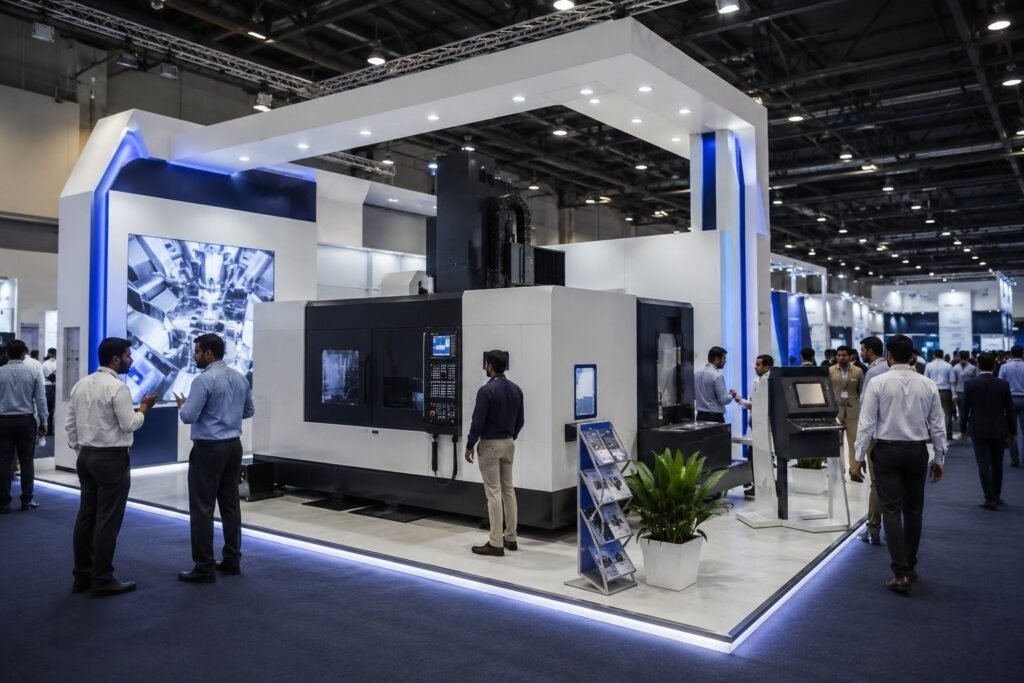
Large engineering machinery can be one of the strongest attractions at an exhibition. A full-size machine immediately communicates scale, capability and technical expertise in a way that a brochure or screen cannot. But the same machinery can quickly consume valuable floor space, block sightlines and create congestion if the booth is planned around the equipment alone. Effective engineering exhibition booth design therefore starts with a different question: not simply where can the machine fit? But how will people move around it, understand it and engage with the brand?
A well-planned machinery booth connects the equipment display with clear circulation, demonstration areas, technical information and spaces for meaningful B2B conversations. The goal is to make the machinery easy to see and experience without turning the booth into an obstacle course. This makes visitor flow a core part of engineering exhibition stall design, rather than something added after the machinery, furniture and branding have already been positioned.
Why Machinery Changes Engineering Exhibition Booth Design
Engineering machinery creates planning requirements that are very different from those of smaller products or graphic-led exhibition displays. A machine may require significant floor area, specialised handling during installation, utility connections, service access and enough surrounding space for visitors to observe it safely. Its position can also influence the entire booth. A large CNC machine, production system or industrial component can block a major sightline if positioned incorrectly. A live demonstration can attract a group of visitors within seconds, turning an otherwise comfortable pathway into a bottleneck. That is why machinery exhibition booth design needs to consider several factors together:
Planning factor | Why it matters |
Machine dimensions | Establishes the physical footprint and available circulation space |
Machine weight | May affect floor and structural planning |
Operating requirements | Determines whether additional working or safety space is needed |
Viewing angles | Influences how the machine should face the aisle and visitor areas |
Service access | Keeps maintenance, utilities and technical access practical |
Installation route | Determines how the equipment can reach its final position |
Demonstration area | Prevents visitors from gathering directly in circulation paths |
Visitor movement | Keeps entry, exploration and exit routes intuitive |
Meeting requirements | Allows sales and technical discussions without interfering with product viewing |
The most effective approach is machinery-first planning. Before deciding on decorative elements, furniture, or graphics, the exhibition team should first understand the machine’s physical and operational requirements. From there, the booth can be organised around a natural visitor journey: Attract → Explore → Experience → Discuss → Convert. This approach allows the machinery to remain the hero of the stand while giving visitors enough space to move, ask questions, pause, and have meaningful conversations. A strong industrial exhibition booth design does not necessarily display the greatest number of machines; instead, it gives the most important equipment enough visibility and context to make an impression without compromising the overall visitor experience.
Start With the Machinery Footprint, Not the Booth Decoration
A common mistake in engineering exhibition booth design is to begin with the visual concept and then try to fit the machinery into it. For an engineering or manufacturing exhibitor, the order should usually be reversed. Start by understanding the equipment. Record the machine’s overall dimensions, access points, weight, operating requirements, utility connections and the way visitors need to view it. Then consider how it will enter the exhibition hall and reach its final position. Only after these practical questions are clear should the design team begin allocating space for demonstrations, meeting areas, graphics, and other displays. This machinery-first approach helps prevent a visually impressive booth from becoming difficult to use once the equipment arrives.
Build the Layout Around the Complete Machine Footprint
The machine itself is only part of the space requirement. Visitors may need room to walk around it, an operator may need access to controls, technicians may require service access, and a demonstration may temporarily attract a group of people. For example, placing a large machine directly beside the main aisle might maximise visibility, but it could also encourage visitors to stop in a location where passing traffic is already high. Moving the machine slightly deeper into the booth, while keeping it visible from the aisle, may create a better balance between attraction and circulation. The planning sequence should therefore look like this: Machine dimensions → Access requirements → Operating area → Viewing area → Visitor circulation → Supporting displays → Meeting areas → Branding. This sequence is particularly important when designing an industrial machinery exhibition booth, where equipment can occupy a substantial portion of the available floor area.
What to Confirm Before Finalising the Booth Layout
Requirement | What the design team should consider |
Machine dimensions | Overall length, width and height, including any parts that extend during operation |
Machine weight | Whether the venue and booth structure can accommodate the equipment |
Operating area | Space required for operators, controls and demonstrations |
Service access | Access needed for maintenance, connections or technical support |
Loading route | How the machine will enter the venue and reach the booth |
Power and utilities | Electrical, compressed air, water or other connections where applicable |
Viewing angles | The sides or features visitors need to see clearly |
Visitor gathering area | Space for people to stop without obstructing the main pathway |
These details should be confirmed before the final booth floor plan is approved. They also need to be coordinated with the exhibition venue and organiser because structural, electrical, loading and safety requirements can vary between venues and events.
Give the Hero Machine Enough Breathing Room
Not every machine needs to occupy the centre of the booth. The more useful question is whether visitors can immediately understand what deserves their attention. If one machine is the company’s flagship product, give it visual and physical priority. Supporting equipment can then be displayed through smaller models, components, technical graphics, video or digital demonstrations. This creates a clearer product hierarchy: Hero machine → Supporting equipment → Technical explanation → Sales conversation. It also prevents a common problem in machinery exhibition stall design: trying to display every product at full scale and leaving almost no usable space for visitors.
Think About Installation Before the Final Render
The booth should work not only for visitors but also for the team installing it. A machine may need to be transported through a particular entrance, moved using specialised equipment or positioned before parts of the booth structure are completed. If those requirements are ignored during design, a beautiful 3D render can become difficult or expensive to execute on site. For this reason, machinery planning should involve the relevant design, production, technical and installation teams early in the process. The best machinery display booth is therefore not simply the one that looks impressive in a render. It is one where the equipment can be installed realistically, operated appropriately, viewed clearly and integrated into a visitor journey that feels natural.
Divide the Engineering Booth Into Functional Zones
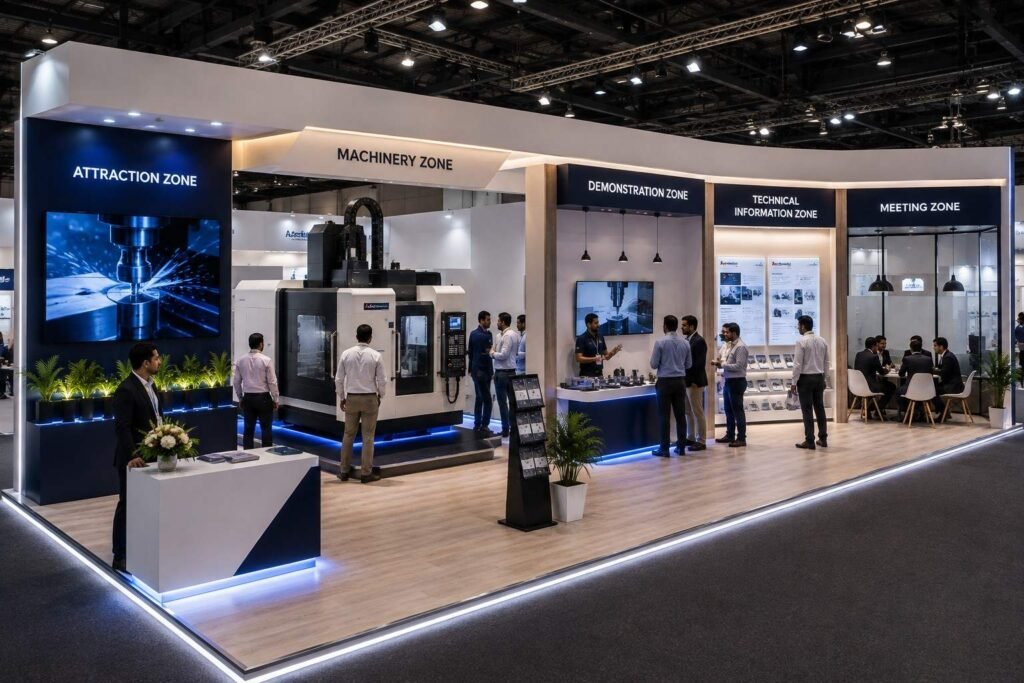
Once the machinery footprint is established, the next step is to decide what needs to happen around it. A successful engineering exhibition booth design should not treat the entire booth as one open area. Different parts of the space have different jobs, and separating those functions can make a machinery-heavy booth easier to navigate. A visitor may first notice the machine from the aisle, move closer to understand what it does, watch a demonstration, ask a technical question and eventually sit down for a business conversation. If all of these activities happen in the same small area, congestion is almost inevitable. A better approach is to create connected functional zones.
1. Attraction Zone
The attraction zone is the part of the booth that catches attention from the aisle. For an engineering company, this could include:
- A flagship machine
- A prominent product feature
- Overhead branding
- A large but concise brand message
- A digital screen showing the machine in operation
The purpose is not to explain everything from a distance. It is to give visitors a clear reason to enter. The attraction zone should also preserve visibility into the booth. Excessive walls, tall furniture or poorly positioned displays can hide the machinery from people walking past.
2. Machinery and Product Zone
This is where the primary equipment takes centre stage. The layout should allow visitors to understand the machine without forcing them into a narrow path. Depending on the equipment, visitors may need to see the front, side, controls or specific working components. For a large industrial machinery exhibition booth, this zone should be planned around the equipment’s actual footprint rather than an assumed rectangle on a floor plan. The machine’s position should also support the wider visitor journey. A visitor should be able to approach it; look around it where appropriate and move towards the next information or demonstration point without having to retrace their steps.
3. Demonstration Zone
A machine demonstration can transform a static display into an experience, but it can also change the traffic pattern within seconds. When a demonstration begins, visitors may gather around the machine, take photographs, ask questions or wait for the next session. The demonstration area therefore needs to account for temporary increases in visitor density. Where possible, position the demonstration area so that:
- The main aisle remains unobstructed
- Visitors have a clear viewing position
- Operators can work safely
- Technical staff can interact with the audience
- The crowd can disperse naturally after the demonstration
This is especially important for a live machinery demo booth, where the audience may be larger than the footprint of the equipment itself.
4. Technical Information Zone
Engineering products often require more explanation than a simple product label can provide. A technical information zone can use:
- Product specifications
- Component displays
- Cutaway models
- CAD or 3D visuals
- Interactive screens
- Application videos
- Diagrams
- Comparison graphics
The objective is to give technically interested visitors a deeper understanding without covering the booth in dense blocks of text. Digital content can be particularly useful when the actual machinery is too large to demonstrate every feature physically.
5. Conversation and Meeting Zone
The final stage of the visitor journey is often a conversation. Engineering exhibitions can involve distributors, procurement teams, technical decision-makers, OEMs and other B2B audiences. These visitors may need more time and privacy than a quick product explanation allows. A meeting zone can therefore include:
- Open discussion tables
- High counters for short conversations
- Semi-private seating
- Enclosed meeting areas for longer discussions
The important point is placement. Meeting furniture should not occupy the most valuable machinery-viewing space or sit directly in a primary circulation route.
How to Plan Visitor Flow Around Large Machinery
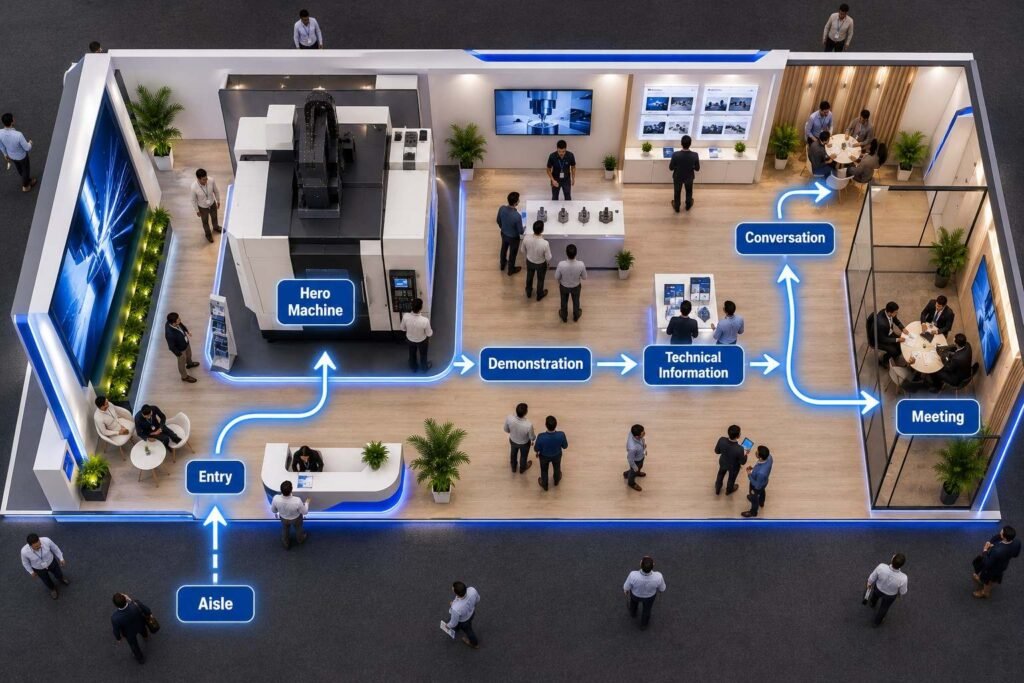
When large machinery takes up a major part of an exhibition booth, visitor movement needs to be considered from the start. A machine may attract attention, but if people cannot comfortably approach it, watch a demonstration, or move on to another part of the booth, the layout can quickly feel crowded. The goal is not to force visitors along one fixed route. It is to make the booth easy to understand and easy to move through, with enough space for people to stop when something catches their interest. A simple visitor journey could be Aisle → Entry → Hero Machine → Demonstration → Technical Information → Conversation → Meeting
Start With an Open Entry
The entrance is where visitors decide whether to step into the booth. Keep this area reasonably open and avoid filling it with furniture, storage or secondary displays. A large machine can be visible from the entrance without being placed directly in the doorway. This gives the booth an immediate focal point while leaving visitors enough room to enter naturally. For an industrial exhibition booth design, this small distinction can make the space feel much more inviting.
Give Visitors a Clear Next Step
Once someone enters, they should quickly understand what to explore next. That could be a live demonstration, a technical display, another product or a salesperson ready to explain the machinery. The transition should feel natural rather than forced. Visitors should be able to look around and make their own choices without getting in the way of others.
Keep Walking Areas Clear
Machinery often becomes a natural stopping point. Someone may stop to take a photograph, another visitor may ask a question, and a salesperson may begin explaining a feature. If this happens directly in the main pathway, other visitors can struggle to get through. This is why it helps to separate circulation space from interaction space. The main route should remain reasonably clear, while areas around the machinery should allow people to stop, look and talk without spilling into the aisle.
Check What Visitors Can See
Good exhibition booth layout is not only about measurements on a floor plan. It is also about what visitors can see as they approach. Before finalising the layout, check:
- Can the hero machine be seen from the aisle?
- Are important features facing the visitor?
- Does a meeting room block the equipment?
- Are tall displays hiding the product?
- Can people watch a demonstration without standing in the main pathway?
- Is the company branding easy to spot?
A machine does not have to sit in the centre of the booth to become the focal point. Sometimes a better position is one that gives it a strong sightline while leaving more room for movement.
Allow for Demonstration Crowds
A live demonstration changes the way people use the booth. A machine that normally has plenty of space around it can suddenly attract a group of visitors. The layout should allow for this temporary crowd. Depending on the machine and booth size, this could mean creating a defined viewing area, using a screen so people farther away can follow the demonstration, or positioning the demonstration away from the busiest route. The important thing is to plan for how people will gather, not just where the machine will stand.
Avoid Creating Dead Ends
Large machines, walls, storage areas, and meeting rooms can easily divide an exhibition booth into disconnected sections. This can make visitors turn back or retrace their steps, especially in smaller spaces. Instead, keep the main areas connected and leave enough open space for visitors to move naturally between the machinery, demonstration area, technical displays, and meeting space. The layout should feel open rather than forcing visitors through a narrow or confusing route. This is particularly important in engineering exhibition booth design, where large equipment already takes up a significant amount of floor space. A well-planned layout gives visitors more than one comfortable way to explore the booth without interfering with people who are stopping to view a machine or speak with a team member.
Keep Meetings Out of the Main Traffic
Once a visitor becomes interested in the machinery, the conversation may move towards specifications, pricing, procurement or project requirements. That conversation needs a little more breathing room. Place meeting tables or discussion areas where people can sit and leave without blocking the main route. This also creates a natural progression from a quick product interaction to a more focused business conversation.
Plan for Different Types of Visitors
Visitors come to engineering exhibitions with different expectations. Some may simply want to see the machinery, while others may be looking for technical details, application information, pricing, or a conversation about a potential project. The booth should be flexible enough to support these different needs without making the space feel crowded. Someone who wants a quick overview should be able to explore independently, while a more interested visitor should have an easy opportunity to speak with a technical or sales representative. This is why visitor flow is not just about keeping pathways clear. It is about creating a booth where people can explore, interact, ask questions, and move into a deeper conversation naturally.
Make the Booth Easy to Navigate
The best visitor flow is usually the one people barely notice. Visitors should not have to think about where to walk or whether they are standing in the wrong place. The machinery should attract attention without blocking movement. Demonstrations should create interest without taking over the booth. Technical information should be available without making the space feel cluttered, and meeting areas should be accessible without hiding the products. When these elements are planned together, exhibition booth visitor flow becomes a natural part of the experience rather than a separate design exercise.
Where Should Machinery Be Placed in an Exhibition Booth?
No single position works for every machine. The right placement depends on the machine’s size, purpose, viewing angle, booth location and how visitors are expected to interact with it. In machinery exhibition booth design, the goal is to make the equipment easy to notice and approach without blocking movement. Three common options are front-facing, central and perimeter placement.
1. Front-Facing Machinery
Placing a machine near the front can give it strong visibility from the aisle. This works well for a flagship product or equipment that needs to attract attention quickly. The main concern is congestion. If visitors, sales staff and demonstration audiences gather around the machine, the entrance can become difficult to navigate. Keeping some open space around the equipment can help maintain a smoother flow.
2. Central Machinery
A machine placed in the centre can become the main focal point, particularly in a larger booth or an island stand where visitors can view it from different sides. This works well for machinery that benefits from 360-degree viewing or live demonstrations. However, the surrounding space needs to be planned carefully so the machine does not split the booth into separate, disconnected areas.
3. Perimeter Machinery
Placing machines along the perimeter can work well when several products need to fit into a smaller booth. It keeps more of the central area open for visitors, demonstrations and conversations. The main consideration is visibility. The machine should be positioned so its important features face the main visitor approach rather than simply being pushed against a wall.
Which Placement Works Best?
Placement | Works well for | Main consideration |
Front-facing | Hero machines and strong aisle visibility | Avoid entrance congestion |
Central | Large booths and 360° viewing | Maintain clear circulation |
Perimeter | Multiple machines and smaller booths | Protect product visibility |
Don’t Put the Biggest Machine in the Centre Automatically
The largest machine does not always need to be the centrepiece. A smaller piece of equipment may be more important if it represents a key technology or has stronger demonstration value. Consider the machine’s business importance, visitor interest and demonstration value before deciding where it should go.
Consider the Booth Location
The same machine position may work differently in an inline, corner or island booth. An island booth can support multiple viewing angles, while a corner booth can use two open sides to improve visibility. In an inline booth, keeping the entrance open becomes especially important.
Orient the Machine for Visitors
Position is only part of the decision. The machine should also face the direction from which visitors are most likely to approach. Consider:
- Which feature will visitors see first?
- Where will the operator stand?
- Where will demonstrations take place?
- Where will visitors gather?
- Can people move past the machine easily?
The best position balances visibility, accessibility and circulation. When these three work together, the machinery attracts attention without becoming an obstacle to the visitor experience.
How to Display Multiple Machines Without Creating Crowding
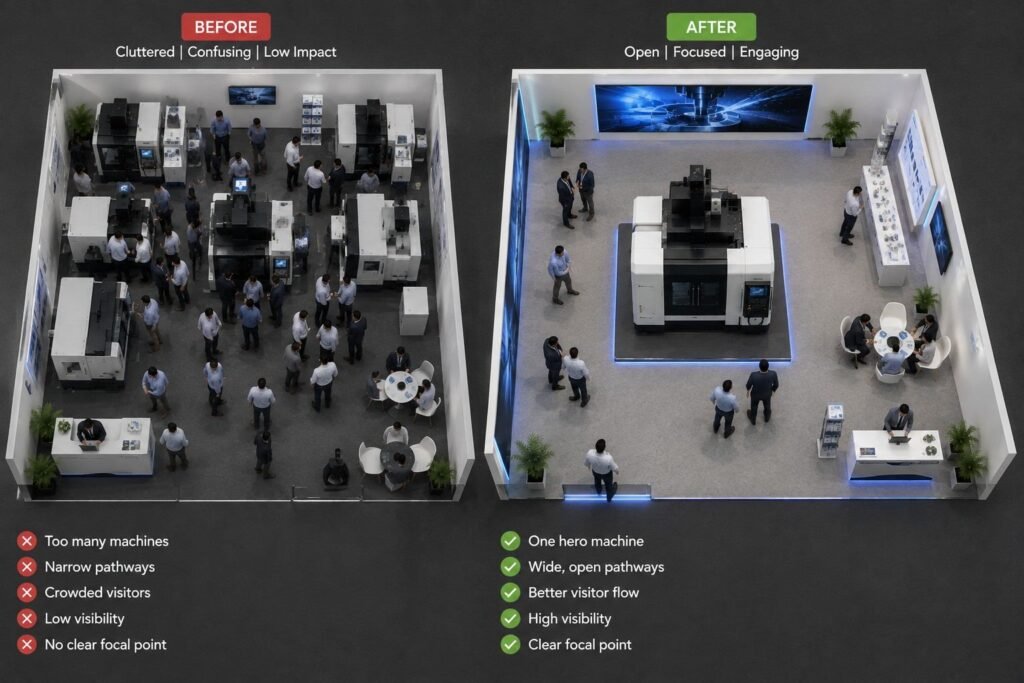
Showing several machines at an exhibition can help visitors understand the breadth of an engineering company, but there is a point where adding more equipment starts working against the booth. Too many machines can make the space difficult to move through and can also make it harder for visitors to understand which products actually matter. In machinery exhibition booth design, the better approach is to decide which products need a physical presence, and which can be explained in other ways. The booth should have a clear product focus rather than looking like a collection of everything the company manufactures.
Give Every Machine a Clear Purpose
Not every machine needs to be the centre of attention. If one product is being launched or is particularly important to the business, give it the strongest position in the booth. Other equipment can then support that main display. For example, a company might bring its flagship machine to the exhibition while using a smaller machine, component display or screen to introduce related products. Visitors still get a sense of the wider product range, but the booth does not become overloaded.
Be Selective With Full-Size Machinery
Seeing a machine at its actual size can make a big difference, especially when visitors need to understand its scale, controls or construction. It is also useful when the equipment will be demonstrated during the event. But not every product needs to occupy several square metres of floor space. Before bringing another machine into the booth, consider whether visitors really need to see it in full size or whether a model, component or digital presentation would explain it just as well. This becomes especially important when the booth also needs space for demonstrations, technical discussions and meetings.
Consider Scaled Models for Oversized Equipment
Some engineering equipment is simply too large or difficult to transport for a particular exhibition. A scaled model can provide a practical alternative without losing the opportunity to show the product. Models are also useful when a company wants to present several machine variants or give visitors an understanding of a larger production system. Adding a few key details or a digital explanation can make the model much more informative.
Show What’s Inside With Cutaway Displays
The most interesting part of an engineering product is not always visible from the outside. A cutaway section or exposed component can help visitors understand the technology behind the machine without taking the actual equipment apart. This works particularly well when the product’s value comes from its internal mechanism, precision components or a particular engineering innovation. It also gives technical visitors something specific to discuss with the team.
Use Digital Content to Support the Physical Display
Digital content is useful when there is more to show than the booth can physically accommodate. A screen can demonstrate a machine operating in a factory, show different configurations or explain how several pieces of equipment work together. It can also be used for product ranges that would otherwise require several additional machines on the floor. In this way, digital content helps extend the display without taking over the booth.
Don’t Try to Show the Entire Product Range
One of the more common mistakes in industrial exhibition booth design is trying to prove the size of the product portfolio by displaying everything at once. The result is often a busy booth where machines compete for attention and visitors have little room to stop and interact. It can also make it harder for the sales team to guide a conversation because there is no obvious starting point. A better approach is to select equipment based on what the exhibition is expected to achieve. A flagship product may deserve a full-size display, while a complementary product might be better represented by a component, model or digital presentation.
Give Machines Some Breathing Room
When several machines are displayed together, they need enough separation to be understood individually. They do not necessarily need walls or large partitions between them. Even a little open space or a change in orientation can make a noticeable difference. The way each machine faces the aisle also matters. If the most important feature is hidden behind another piece of equipment, visitors may walk past without understanding what makes the product worth exploring.
Walk Through the Booth Before Finalising It
A floor plan can look perfectly organised from above and still feel awkward when experienced at ground level. One useful way to test the layout is to walk through it from the visitor’s perspective. Look at the booth from the aisle and consider what catches your eye first. Then move closer to the machinery and see whether there is enough room to stop without getting in someone else’s way. Check whether the next product or information point is easy to find and whether a visitor can reach a salesperson without blocking the main route. These simple checks can reveal problems before the booth reaches the exhibition floor.
More Machines Don’t Always Create More Impact
The purpose of an engineering booth is not to fit as much equipment as possible into the available area. Visitors should leave with a clear understanding of the products that matter most. A well-positioned hero machine, supported by a useful demonstration and relevant technical information, can make a stronger impression than several machines packed closely together. For engineering exhibition booth design, the smarter strategy is often to display fewer products physically and use models, components and digital content to complete the story. This keeps the booth easier to navigate while giving visitors enough space to explore the machinery and have meaningful conversations.
Use Digital Displays to Explain What Machinery Cannot Show
Large machinery can attract attention on its own, but visitors may still need more information to understand how it works, what happens inside it, or how it performs in a real production environment. This is where digital content can support engineering exhibition booth design. The aim is not to replace the machine, but to explain the parts that visitors cannot easily see.
Let the Machine Show Its Physical Value
A full-size machine gives visitors a clear sense of its size, construction, controls and overall quality. For engineering products, seeing the equipment in person can create a much stronger impression than looking at a photograph. When bringing the equipment to the exhibition is practical, it should remain the main attraction, with other content supporting what visitors see in front of them.
Use Demonstrations to Show How It Works
A live demonstration allows visitors to see the machine in action. It can explain a production process, operating feature, control system or specific application much more clearly than static graphics. The demonstration area still needs to be planned carefully, because a popular demonstration can attract a crowd and affect movement around the rest of the booth.
Use Models and Cutaways for Hidden Features
Some important engineering features cannot be seen from the outside. A cutaway model or component display can make internal mechanisms easier to understand without taking apart the actual machine. This can help explain internal components, mechanical systems, material movement and other technical features that might otherwise require a lengthy explanation from the sales team.
Use 3D Visuals for Large or Complex Systems
Some machinery is simply too large to bring to an exhibition. In these situations, 3D visuals can help visitors understand the equipment without using additional floor space. They can show different configurations, production lines, internal views or how a machine fits into a larger manufacturing setup. This can be particularly useful for an industrial machinery exhibition booth where available space is limited.
Show the Machine in Its Real Environment
A machine on the exhibition floor shows what the equipment looks like, but visitors may also want to know how it works in an actual production environment. Short videos can show the machine operating in a factory, handling materials, completing a production process or being integrated into a larger system. Keeping the content focused makes it easier for visitors to understand without asking them to stop for a long corporate presentation.
Keep Technical Information Simple
Engineering products often come with a large amount of technical information, but displaying every specification on the booth can make the space difficult to read. A better approach is to present the information in layers, starting with the main message and a clear visual before offering detailed specifications through a screen, product material or conversation with the technical team. This allows both quick visitors and technical buyers to find the level of information they need.
Don’t Let Screens Take Attention Away from the Machine
Digital displays should support the machinery rather than compete with it. If a large LED screen becomes more noticeable than the actual product, the main purpose of the booth can easily get lost. The visual hierarchy should remain clear, with the hero machine receiving attention first and digital content helping visitors understand its features, applications or performance.
Use Digital Content to Save Floor Space
Digital content can also reduce the need to display every product physically. Additional machine models, configurations and applications can be shown through screens or interactive content instead of taking up valuable floor space. This leaves more room for visitor movement, demonstrations, technical discussions and meetings.
The strongest machinery exhibition booth design uses physical and digital elements together. The machine provides the real-world experience, while digital content fills in the information that visitors cannot easily see from the physical display.
Plan Safety, Structural Loads and Service Access
Large machinery brings practical requirements that a standard product display may not have. Weight, floor loading, electrical connections, operating space and service access all need to be considered before the booth design is finalised. This makes safety and structural planning an important part of engineering exhibition booth design, rather than something checked just before the event. The exact requirements will depend on the machinery, venue and exhibition organiser, so the design team should confirm technical details with the relevant professionals instead of relying on standard assumptions.
Consider Machine Weight and Floor Requirements
The weight and size of the machine can affect how it is transported, positioned and supported inside the exhibition hall. Before approving the layout, confirm the equipment dimensions, weight, weight distribution and flooring requirements. If the booth includes a raised platform, the platform and machinery should also be planned together. A good industrial exhibition booth design needs to work in the real exhibition environment, not just look right in a 3D render.
Allow Enough Space Around the Machinery
The machine itself is not the only space requirement. Operators may need room to work, visitors may need space to observe, and technicians may need access for maintenance or adjustments. This becomes even more important when the equipment will be running during the exhibition. A machine that looks comfortably positioned while switched off may require more space once visitors gather around it. The layout should therefore account for the way the machinery will actually be used rather than treating its physical dimensions as the complete footprint.
Plan Utilities and Service Access Early
Large equipment may require more than a standard electrical connection. Depending on the machine, the booth could also need compressed air, water, data or other specialised services. These requirements should be confirmed before flooring, platforms and booth structures are produced. Service points should remain accessible to technicians, while cables and utility routes should be kept away from visitor pathways wherever possible. This is particularly important in machinery exhibition stall design, where technical requirements can directly affect the layout.
Make Operating Machinery Safe for Visitors
If the machine will be running during the exhibition, visitors need to understand where they can stand and how close they can get. Depending on the equipment, this may require guarding, barriers, controlled access or clearly defined viewing areas. Safety measures do not have to make the booth look closed or uninviting. They can be incorporated into the design through clear viewing zones, appropriate barriers and well-placed signage while keeping the machinery visible. The equipment manufacturer’s guidance, venue requirements and applicable safety regulations should always take priority.
Consider Installation and General Access
Safety planning starts before the exhibition opens. The team needs to know how the machinery will enter the hall, how it will be moved into position and when utilities and testing can take place. The booth should also leave enough room for visitors and staff to move comfortably. Emergency and accessibility requirements need to be considered alongside the machinery rather than after the floor plan has already been finalised.
Review Everything Before Fabrication
Before production begins, the machinery and booth should be reviewed as one plan. Check whether the equipment can reach its intended position, whether the floor and structure can support it, whether utilities are accessible and whether visitors can move around it comfortably. A successful engineering exhibition booth design needs to look impressive, but it also needs to work safely and practically. When weight, access, utilities, servicing, installation and visitor movement are considered from the beginning, the machinery becomes an integrated part of the booth instead of a problem to solve at the last minute.
Plan Machinery Installation Before Booth Fabrication
A machinery-heavy booth needs to be planned for installation just as carefully as it is planned for visitors. A machine may fit comfortably in the final floor plan but still be difficult to bring into the hall or position correctly if the installation route has not been considered. For this reason, engineering exhibition booth design should account for machinery movement, venue access, utilities and testing before fabrication begins.
Plan the Machine’s Route into the Booth
Start by understanding how the equipment will travel from the loading area to its final position. Check the available hall entrances, doorways, access restrictions and handling arrangements with the exhibition organiser and venue team. This is particularly important for large or heavy equipment. A wall-raised platform or completed booth structure could easily become an obstacle if the machine needs to pass through that area first.
Decide the Installation Sequence Early
The order in which the booth and machinery are installed can make a significant difference. In many cases, the machine may need to be positioned before certain walls, platforms or display structures are completed. The installation team should agree on this sequence in advance, including when the machinery will be moved, connected and tested. This reduces the chance of making last-minute changes once the booth is being built.
Coordinate Flooring, Platforms and Utilities
Heavy machinery and raised flooring need to be considered together. The team should confirm the machine weight, platform requirements, floor loading and the way cables or other connections will reach the equipment. Utilities such as electricity, data, compressed air or water should also be planned before the booth is fabricated. Leaving these details until installation can lead to exposed cables, difficult access or changes to the finished design.
Allow Time for Testing
Getting the machine into position does not mean the installation is finished. If it will be operated during the exhibition, the team needs enough time for connections, functional checks, safety checks and demonstration preparation. Staff should also be familiar with the equipment and understand how the demonstration will be managed. This is especially important when the machinery is the main attraction of the booth.
Keep Everyone Working From the Same Plan
Machinery installation usually involves several teams, including the booth designer, fabricator, machinery supplier, technical crew and venue representatives. Problems can arise when each team is working with different information. The approved floor plan should therefore include the machine position, access route, utility requirements and relevant structural details. Keeping these details coordinated makes the installation process much smoother.
Check the Booth After Installation
Once the machine is in position, review the booth from a visitor’s perspective. Make sure the equipment is still visible from the aisle, the entrance remains easy to find, and visitors can move around the machine comfortably. Also check that demonstrations, technical displays and meeting areas still work as intended. Sometimes the actual installed machinery changes how the space feels compared with the original design. A strong engineering exhibition stall design should therefore be practical from the moment the machinery enters the venue until the exhibition closes. Planning installation early helps avoid last-minute changes and ensures the finished booth looks good while remaining workable for visitors, staff and technical teams.
Design Meeting Spaces Without Sacrificing Machinery Visibility
An engineering exhibition booth often has two jobs to do at the same time: showcase machinery and provide a place for serious business conversations. Technical teams, distributors, procurement managers and potential customers may all need time to discuss the products in more detail. The challenge is to create comfortable meeting areas without allowing furniture or enclosed rooms to take over the booth.
Match the Meeting Space to the Visitor
Not every visitor needs a formal meeting. Some may simply want to look at the machinery, while others may have questions about specifications, pricing or a potential project. For this reason, it can be useful to have a mix of informal and more private conversation areas. An open table can work well for quick discussions, while a semi-private or enclosed space may be more suitable for longer business conversations. The amount of meeting space should depend on the type of visitors the exhibition is expected to attract and the purpose of the event.
Keep Meeting Areas Away From Main Traffic
Tables and chairs placed too close to the main walkway can quickly create congestion. People sitting down, standing up or joining a conversation can unintentionally block visitors moving through the booth. Meeting areas should have enough space around them for people to enter and leave without interfering with the machinery display or the main circulation route. This becomes particularly important in a compact industrial exhibition booth design, where even a small table can affect the overall flow.
Keep the Machinery Within Sight
Meeting areas should not completely separate visitors from the products they came to see. When a technical conversation develops after a demonstration, it should still be possible to refer back to the machine, a component or a digital presentation. Where possible, keep the hero machinery visible from the meeting area. This creates a natural connection between the product experience and the business conversation.
Use Screens Only When They Add Value
A screen can be useful during a meeting when the conversation involves technical drawings, product configurations, applications or demonstration footage. However, it does not need to become another major visual element in the booth. The machinery should remain the main focus, while digital content can be brought into the conversation when it is actually needed.
Consider Staff Movement
The booth also needs to work for the people operating it. Sales staff may need to move between visitors, bring technical specialists into meetings, retrieve information or return to the machinery for demonstrations. If meeting tables are placed in the middle of these routes, staff movement can quickly interfere with visitors. A well-planned meeting area should therefore connect easily with the rest of the booth without occupying its busiest pathway.
Don’t Hide the Booth Behind Meeting Rooms
Large enclosed meeting rooms can become visual barriers. If one is placed between the aisle and the machinery, visitors may not even realise what the booth is showcasing. For an engineering exhibition booth design, keeping larger meeting structures toward the rear or using more open forms of separation can help maintain sightlines. The machinery should remain visible from the main visitor approaches wherever possible.
Let the Exhibition Objective Decide
The right amount of meeting space depends on what the exhibitor wants to achieve. A product launch may need more room for demonstrations and visitor interaction, while a B2B-focused exhibition may justify a larger area for meetings. There is no benefit in creating a large meeting room simply because the booth has enough space for one. The space should earn its place by supporting the way visitors are expected to engage with the company. A good engineering exhibition stall design allows the experience to develop naturally from seeing the machinery and asking questions to having a more focused business conversation without sacrificing the visibility or accessibility of the products.
Use Lighting and Branding to Guide Visitor Attention
A large machine can naturally attract attention, but it is still competing with dozens of other booths, screens and displays in a busy exhibition hall. Lighting and branding help visitors understand the booth quickly and identify what deserves their attention. In engineering exhibition booth design, these elements should support the machinery rather than compete with it.
Make the Brand Easy to See
Visitors should be able to identify the company before they even enter the booth. Clear branding on overhead structures, fascia, walls or other visible areas can help with this. The messaging should also be simple. Instead of filling the booth with long technical statements, focus on communicating who the company is, what it offers and what makes its products relevant. More detailed information can be introduced once visitors move closer to the machinery.
Use Lighting to Create Focus
Lighting does more than brighten the booth. It can help guide attention toward the machine, an important feature or a particular display. A flagship machine might receive more focused lighting, while supporting areas can use softer or more consistent illumination. If everything is lit with the same intensity, it becomes harder for visitors to understand what they should notice first.
Highlight Important Machine Features
Sometimes the most important part of a machine is not its overall appearance. It may be a control system, robotic component, precision mechanism or another technical feature. Lighting can draw attention to these details, particularly when combined with a short explanation or supporting graphic. The idea is not to make every part of the machine brighter, but to help visitors notice what is worth asking about.
Keep Technical Graphics Simple
Engineering booths often have a lot of information to communicate, but large blocks of specifications can quickly make the space difficult to read. Start with the main product benefit or message, then use a relevant image, diagram or key specification to support it. Visitors who want more detail can explore the technical information through digital content or speak with the team. This keeps the booth approachable without losing the technical depth expected by engineering audiences.
Use Digital Displays With a Purpose
Screens and LED walls can be useful for showing machinery in operation, factory applications, product configurations or technical processes that cannot be demonstrated on the exhibition floor. However, the content should have a clear connection to the product. Constant animation or unrelated visuals may attract attention, but they do not necessarily encourage a meaningful conversation. For machinery exhibition booth design, digital content works best when it helps visitors understand something the physical machine cannot show on its own.
Don’t Let the Screen Become the Main Attraction
A large LED wall can easily overpower a physical machine, particularly when it is brighter or more visually active. If the machinery is the main reason visitors should enter the booth, it needs to remain visually prominent. Screens, branding and architectural elements should frame the product rather than hide it. This is especially important with large engineering equipment, where the physical scale and presence of the machine are part of the visitor experience.
Use Brand Colours Carefully
Brand colours can make a booth recognisable, but using too many colours across walls, furniture, graphics and lighting can make the space feel busy. A more controlled use of colour can come through architectural details, signage, graphics and selected furniture or lighting elements. This gives the booth a consistent identity while allowing the machinery to remain the main focus.
Check the Booth From Different Angles
Visitors may approach a booth from different directions, particularly when it is located on a corner or island space. Check the design from each major approach to make sure the company name, hero machine and main message remain visible. Also look for anything that could block an important product feature or make the booth appear closed from one side.
Keep Lighting Practical
Lighting should also work with the machinery itself. Glare on control panels, screens, or glossy surfaces can make products harder to see. Lighting equipment should not interfere with demonstrations, maintenance or technical access either. These details are easier to manage when lighting is planned alongside the machinery and booth structure rather than added at the end.
Win Attention Quickly
Visitors walking through a busy exhibition hall may only give a booth a few seconds of attention. During that time, the design should make it clear who the company is, what it offers and what visitors should look at. That is where branding, lighting and machinery need to work together. A strong engineering exhibition stall design uses branding to establish recognition, lighting to guide attention and the machinery itself to provide the real product experience.
Small vs Large Booth: Which Machinery Layout Works Best?
The right machinery layout depends on the booth size, configuration, equipment and purpose of the exhibition. A layout that works well in a large island booth may feel crowded in a small inline space. The key is to use the available floor area according to what the machinery needs to achieve and how visitors are expected to interact with it.
Booth Size and Machinery Layout
Booth Type | Recommended Machinery Layout | What to Focus On |
Small Booth | One hero machine with supporting digital content or a compact model | Keep the layout open and focused |
Medium Booth | Hero machine with a demonstration and meeting area | Balance product display with interaction |
Large Booth | Multiple machines organised into product or application zones | Make each area easy to understand |
Island Booth | Central or distributed machinery with open access from multiple sides | Maximise visibility and 360° viewing |
Corner Booth | Use both open sides for machinery and visitor access | Create multiple entry and viewing points |
Linear Booth | Machinery along the perimeter with a clear route from the aisle | Maintain a strong front-to-back flow |
Common Engineering Exhibition Booth Design Mistakes
Even a well-designed exhibition booth can struggle if the machinery, visitor movement and business goals are planned separately. Most problems come from small layout decisions that create congestion, hide important products or make the booth difficult to navigate. Here are five common mistakes to watch for when planning engineering exhibition booth design, along with practical ways to avoid them.
1. Trying to Display Too Many Machines
A large product range does not mean every machine needs to be physically displayed. Filling the booth with equipment can leave little room for visitors, demonstrations or conversations, while also making it difficult to see which product deserves attention.
How to avoid it: Choose the machines that are most important for the exhibition and use models, components, videos or digital displays to represent the rest of the range. Give the hero product enough space to stand out.
2. Ignoring the Complete Machine Footprint
The machine’s dimensions are only part of the space it requires. Operators, visitors, technicians and demonstration audiences may all need room around the equipment. A layout that looks fine on a floor plan can feel very tight once the machine is actually being used.
How to avoid it: Plan around the machine’s full operating and service requirements, not just its physical dimensions. Consider how visitors will approach it, where staff will stand and how people will move around it during a demonstration.
3. Blocking Visibility and Visitor Movement
Large machines, meeting rooms, furniture and tall structures can easily block important sightlines or create bottlenecks. Visitors may struggle to see the main product or move comfortably through the booth.
How to avoid it: Check the layout from the main visitor approaches before fabrication. Keep the entrance reasonably open, protect the main circulation route and make sure the hero machinery remains visible from the aisle.
4. Leaving Technical and Installation Requirements Until the End
Power connections, service access, machinery installation and handling requirements are often overlooked when the focus is mainly on the visual design. Last-minute changes can then affect the structure, flooring or visitor-facing areas.
How to avoid it: Bring the machinery supplier, technical team, fabricator and venue requirements into the planning process early. Confirm installation routes, utilities, floor requirements and service access before the booth goes into production.
5. Designing for Appearance Instead of the Visitor Experience
A booth can look impressive in a render but still be uncomfortable to use. Too many screens, graphics, machines or decorative structures can make the space visually busy and distract from the products.
How to avoid it: Walk through the booth from a visitor’s perspective before finalising the design. Ask whether the main machine is easy to see, whether visitors can move around it, whether demonstrations have enough space and whether there is a natural place for a conversation.
How to Measure Whether the Booth Layout Is Working
A successful engineering exhibition booth design should do more than look good. It should attract the right visitors, encourage them to engage with the machinery and create opportunities for useful business conversations. Measuring these things can show what worked and what needs to change at the next exhibition.
Start With the Exhibition Goal
First, decide what the booth is expected to achieve. It could be product demonstrations, technical discussions, new product enquiries, meetings, qualified leads or brand awareness. The metrics you track should match that goal.
Look at Visitor Engagement
Visitor numbers are useful, but they do not tell the whole story. Pay attention to how many people enter the booth, stop at the machinery, take part in demonstrations or speak with the team. If many people walk past but very few stop, the booth may need a stronger visual attraction or clearer messaging.
Track Meaningful Conversations
For engineering companies, a technical conversation can be more valuable than a quick visit. Note how many visitors ask about specifications, applications, machine capabilities or potential projects. This helps separate general footfall from genuine product interest.
Measure Leads and Meetings
Do not focus only on the total number of leads. Look at their quality as well. A product enquiry, technical discussion, project opportunity or distributor conversation can tell you much more about whether the booth attracted the right audience. Meeting numbers and follow-up opportunities can also show whether the meeting area is supporting the visitor journey.
Watch Where Visitors Gather
During the exhibition, observe where people naturally stop. If visitors regularly gather around one machine or demonstration, that may indicate strong interest. If the same area repeatedly becomes difficult to navigate, the layout may need adjustment. These observations can reveal problems that are difficult to see in a floor plan.
Review What Happened After the Event
Once the exhibition is over, compare visitor engagement, lead quality, meetings, demonstrations and staff feedback. Look at which machines attracted the most interest and which areas were rarely used. This information can guide the next engineering exhibition stall design and help avoid repeating the same layout problems. The aim is simple: plan, observe, measure and improve. A booth should not only look successful; it should provide useful results that help make the next exhibition better.
Conclusion
Effective engineering exhibition booth design is about balancing machinery visibility with comfortable visitor movement. Start with the equipment’s footprint, safety and installation requirements, then build clear zones for demonstrations, technical information and B2B conversations. The goal is simple: make the right machinery easy to see, understand and discuss without creating congestion. A well-planned booth should work not only as a display, but as a smooth visitor journey from attraction to engagement and business conversation.
FAQs
1. What is engineering exhibition booth design?
Engineering exhibition booth design is the planning of an exhibition space around engineering products, machinery, technical information, demonstrations and visitor movement. It combines product positioning, space planning, branding, safety, demonstrations and meeting areas to create a booth that is both practical and engaging.
2. How do you display large machinery in an exhibition booth?
Start with the machine’s dimensions, weight, access requirements, operating area and viewing angles. Then position it according to its role in the visitor journey. Large machinery can be supported with demonstrations, technical graphics, models or digital content so the booth does not become overcrowded.
3. How do you balance machinery displays with visitor flow?
Balance machinery displays with visitor flow by treating the equipment footprint and circulation as connected design requirements. Maintain clear movement around the machine, provide defined demonstration and interaction areas, protect important sightlines and avoid placing furniture or displays where visitors naturally need to walk.
4. Where should machinery be placed in an exhibition booth?
There is no universally correct position. Front-facing machinery can provide strong aisle visibility, central placement can work well for 360-degree viewing, and perimeter placement can preserve central circulation. The best position depends on the machine, booth configuration, visitor approach and exhibition objective.
5. How much space should be left around exhibition machinery?
There is no single clearance that applies to every machine. The required space depends on the equipment, how it operates, whether it will be demonstrated, service requirements, venue rules and applicable safety requirements. The layout should be reviewed with the relevant technical and venue teams before installation.
6. What is the best booth layout for heavy machinery?
The best layout is the one that gives the machinery strong visibility while maintaining safe and practical circulation. A hero machine can anchor the booth, while demonstrations, technical displays and meeting areas are positioned around the visitor journey. Larger booths may support multiple product zones, while smaller booths often benefit from a more focused display.
7. How can multiple machines be displayed in a small exhibition booth?
Prioritise the most important machine as the physical hero product and represent other products through scaled models, components, digital catalogues, videos, technical graphics or interactive displays. This creates a stronger product hierarchy while preserving valuable space for visitor movement and conversations.
8. What safety considerations are important for machinery displays?
Machinery displays may require consideration of equipment weight, floor loading, operating conditions, visitor access, protective measures, electrical connections, service access and emergency pathways. Requirements vary according to the equipment and venue, so the design should follow manufacturer guidance, organiser requirements and applicable regulations.
9. How can digital displays improve a machinery exhibition booth?
Digital displays can explain information that is difficult to show physically, such as internal mechanisms, production processes, different configurations, factory applications and technical specifications. They can also reduce the need to display every machine at full scale, helping preserve floor space for visitors, demonstrations and meetings.
10. How much does an engineering exhibition booth cost in India?
There is no standard price for an engineering exhibition booth. Cost can vary significantly based on booth size, design complexity, machinery requirements, structural work, graphics, flooring, lighting, AV, furniture, fabrication, transportation, installation and dismantling. A meaningful estimate requires the project scope, venue and equipment requirements to be assessed.