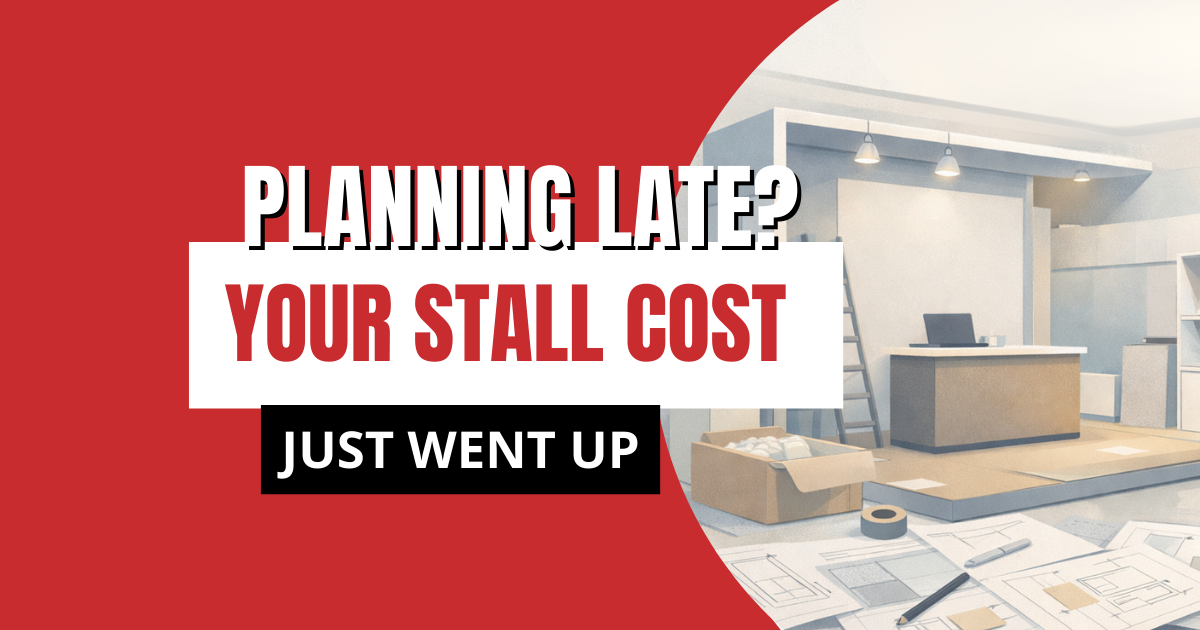
Most exhibition budgets don’t fail because of poor planning intent; they fail because of delayed execution. When exhibition stall design and fabrication are pushed to the final weeks or days, costs don’t spike visibly at first. Instead, they accumulate quietly, line by line, until the final invoice bears little resemblance to the original estimate. In India’s high-pressure exhibition circuits Delhi, Mumbai, Bangalore, Ahmedabad, and Hyderabad tight timelines trigger a chain reaction across design, fabrication, logistics, and labour. Brands don’t just pay for a stall; they pay for urgency, inefficiency, and lost negotiating power. Below is a detailed breakdown of where those hidden costs come from and why last-minute planning almost always costs more than expected.
1. Premium Pricing on Materials Due to Immediate Procurement
When timelines shrink, material sourcing becomes reactive rather than strategic.
What changes at the last minute:
- Vendors can’t wait for bulk rates or distributor discounts
- Standard materials may be unavailable, forcing substitutions
- Fabricators source from local markets at retail or emergency prices
Hidden cost impact:
- Higher per-unit material rates
- Increased wastage due to rushed cutting and fitting
- Paying extra for “available now” instead of “best suited” materials
In contrast, early planning allows fabricators to forecast material needs, negotiate pricing, and reduce excess usage.
2. Design Shortcuts That Lead to Rework Costs
Last-minute design approvals often mean layouts are finalised under pressure.
What happens in rushed design cycles:
- Limited time for 3D iterations and feasibility checks
- Structural issues discovered during fabrication
- Branding elements adjusted too late to print efficiently
Hidden cost impact:
- Partial dismantling and re-fabrication
- Reprinting graphics at express rates
- Paying twice for design corrections that could’ve been avoided
The cost isn’t just financial, it’s time lost on the shop floor when every hour matters.
3. Fabrication Inefficiencies and Overtime Labour Charges
Fabrication thrives on planned workflows. Urgency breaks that system.
In last-minute projects:
- Workshops reprioritise your stall over scheduled jobs
- Labour works extended shifts, nights, or weekends
- Mistakes increase due to fatigue and speed pressure
Hidden cost impact:
- Overtime wages and emergency labour premiums
- Lower production efficiency
- Increased risk of on-site fixes during installation
These costs rarely appear as a single line item; they’re spread across fabrication, manpower, and contingency charges.
4. Express Logistics and Transport Escalations
Exhibition logistics are time-sensitive even in ideal conditions. Last-minute planning removes all flexibility.
Typical urgent logistics scenarios:
- Dedicated trucks instead of shared loads
- Night movement permits and toll surcharges
- Backup vehicles in case of delays
Hidden cost impact:
- 25–50% higher transport costs
- Additional handling and loading labour
- Last-minute warehousing or holding charges
In metro venues like Pragati Maidan, BEC Mumbai, or BIEC Bangalore, even a few hours’ delay can multiply costs dramatically.
5. Venue Penalties and Limited Installation Windows
Indian exhibition venues operate on strict schedules.
Last-minute stalls often face:
- Missed early access windows
- Higher charges for extended installation hours
- Fines for late completion or unsafe structures
Hidden cost impact:
- Paying venue overtime fees
- Emergency manpower deployment
- Rushed installations that affect finish quality
What seems like a “design delay” often turns into a venue compliance cost.
6. Compromised Vendor Negotiation Power
Time is leverage. When time disappears, so does your ability to negotiate.
With early planning, brands can:
- Compare multiple stall design vendors
- Negotiate package pricing
- Lock rates before seasonal spikes
With last-minute planning:
- Vendors quote urgency-based pricing
- Fewer choices force acceptance of higher costs
- Discounts disappear entirely
7. Increased On-Site Contingency Spending
Rushed stalls rarely arrive “show-ready.”
Common last-minute fixes include:
- Extra electricians or carpenters on site
- Emergency graphic reprints
- Structural reinforcements after inspection
Hidden cost impact:
- Cash payments for on-site labour
- Unplanned vendor coordination
- Stressful decision-making under time pressure
These expenses are rarely forecasted but almost always incurred.
8. Long-Term Brand and ROI Losses (The Cost No Invoice Shows)
Some costs never appear on paper but they hurt the most.
Last-minute design often leads to:
- Poor visitor flow and congestion
- Weak brand visibility
- Missed lead-generation opportunities
Hidden impact:
- Lower footfall-to-lead conversion
- Reduced engagement time
- Underwhelming post-show ROI
Even if the stall “looks fine,” rushed execution often limits business outcomes.
The Real Hidden Costs of Rushed Exhibition Stall Design
When exhibition stall design is rushed, the damage doesn’t show up as one big mistake. Instead, costs quietly appear across design, fabrication, logistics, installation, and performance. By the time brands realise what’s happening, the exhibition is already underway and budgets are no longer controllable.
Below are the real, often ignored hidden costs of last-minute exhibition stall planning.
1. Emergency Fabrication & Overtime Labour Costs
Tight deadlines force fabrication teams into crisis mode.
What happens behind the scenes:
- Fabricators extend shifts late into the night
- Weekend and overnight labour is deployed
- Supervisors are added to fast-track approvals
Hidden cost impact:
- Overtime wages (often 1.5x to 2x standard rates)
- Extra supervision and quality control costs
- Higher error rates due to fatigue, leading to rework
In Indian exhibition stall fabrication, labour is affordable only when timelines are planned. Urgency makes it expensive.
2. Premium Material Sourcing Due to Time Constraints
When time is limited, choice disappears.
Common last-minute material issues:
- Preferred laminates, acrylics, or fabrics unavailable
- Imported or custom materials ruled out completely
- Vendors forced to buy from retail markets
Hidden cost impact:
- Higher per-square-foot material pricing
- Compromised finishes that affect brand perception
- Increased wastage due to rushed cutting and fitting
Early exhibition stall design allows price negotiation and bulk sourcing last-minute work does not.
3. Express Logistics, Freight & Handling Charges
Logistics is one of the biggest hidden cost centres in rushed exhibition projects.
What changes with last-minute logistics:
- Dedicated trucks instead of shared transport
- Emergency loading, unloading, and night movement
- Backup vehicles arranged to avoid delays
Hidden cost impact:
- Transport costs increase by 25–50%
- Additional labour for fast loading and unloading
- Last-minute storage or holding charges near venues
At venues like Pragati Maidan (Delhi) or BEC Mumbai, delayed entry can multiply logistics costs instantly.
4. Design Revisions, Reprints & Refabrication Expenses
Fast design decisions often mean slow realisation of mistakes.
Why revisions increase in rushed projects:
- Limited time for 3D visualization and walkthroughs
- Branding teams approve layouts without testing visibility
- Structural feasibility checked too late
Hidden cost impact:
- Reprinting graphics at express rates
- Partial dismantling and refabrication
- Additional design and coordination fees
What looks like a “small change” on screen becomes expensive once fabrication has begun.
5. Weak Stall Layout That Reduces Lead Generation
Not all costs appear on invoices.
Common performance issues in rushed exhibition stalls:
- Poor visitor flow and congestion
- Inadequate demo or meeting spaces
- Branding that’s visible but not readable
Hidden business cost:
- Fewer qualified leads
- Shorter visitor engagement time
- Poor post-exhibition ROI
A stall may look complete but if it doesn’t convert visitors, the exhibition investment underperforms.
6. Venue Compliance, Utility & Approval Charges
Late coordination with exhibition venues almost always results in extra fees.
Typical issues:
- Delayed electrical load planning
- Late rigging and hanging approvals
- Internet, AV, and safety requests made on-site
Hidden cost impact:
- Premium utility charges
- Emergency approval fees
- Last-minute vendor dependency inside the venue
Indian venues operate on strict schedules. Missing deadlines means paying more—no exceptions.
7. On-Site Installation Fixes & Emergency Corrections
Rushed stalls arrive on-site with unresolved issues.
Common on-site problems:
- Misaligned panels or graphics
- Electrical points placed incorrectly
- Structural instability detected during installation
Hidden cost impact:
- Extra carpenters and electricians on-site
- Replacement materials sourced locally at high prices
- Extended installation hours and venue overtime
These costs rarely appear in initial budgets but they almost always occur.
8. Vendor Risk Premium & Limited Negotiation Power
Time pressure shifts power away from the brand.
With early planning:
- Multiple exhibition stall design companies can be evaluated
- Competitive quotes keep pricing realistic
With last-minute planning:
- Vendors price for urgency and risk
- Discounts disappear
- Choices become limited to “who is available”
You’re no longer buying value, you’re buying speed.
9. Brand Image Damage from Compromised Finish Quality
Rushed execution often sacrifices detailing.
What visitors notice:
- Uneven finishes
- Visible joints and wiring
- Inconsistent branding
Hidden long-term cost:
- Reduced brand credibility
- Lower trust among B2B visitors
- Missed partnership opportunities
In exhibitions, perception equals positioning.
10. Stress, Decision Fatigue & Internal Team Burnout
One of the most underestimated costs is internal strain.
Last-minute projects cause:
- Constant approvals under pressure
- Poor coordination between marketing, vendors, and sales
- Decision-making without data or testing
This doesn’t just affect one exhibition it impacts future planning and confidence.
The Smarter Alternative: Early Exhibition Stall Planning
The smarter alternative for exhibitors is early exhibition stall planning. Brands that begin planning their exhibition stalls 8–12 weeks in advance consistently see better outcomes across every stage of the process. Early planning allows for controlled exhibition stall costs, as there is enough time to compare vendors, optimize materials, and avoid expensive last-minute decisions. It also results in better material quality, since designers and fabricators can focus on precision and finishing rather than rushing execution. With adequate lead time, installation becomes smoother and more efficient, unexpected delays and reducing on-site stress. Most importantly, a well-planned stall creates a stronger visitor experience, leading to higher lead generation and improved ROI. In the exhibition ecosystem, time is not a buffer; it is a powerful cost-saving and performance-enhancing tool.
Last-Minute Exhibition Stall Design in India – What Brands Don’t Expect
Last-minute exhibition stall design is challenging anywhere, but in India, it becomes exponentially more complex due to city-specific regulations, venue rules, labour systems, and logistics constraints. Unlike markets with flexible build windows and centralized systems, Indian exhibitions run on tight schedules, layered approvals, and heavy reliance on local execution partners.
When planning time shrinks, these regional realities don’t just slow execution they directly increase cost, risk, and uncertainty.
Below is a detailed breakdown of what brands often underestimate when rushing exhibition stall design in India.
1. Strict Venue Setup Windows Leave No Recovery Time
Indian exhibition venues operate on non-negotiable setup and dismantling schedules.
What brands don’t expect:
- Limited daily installation hours
- Fixed entry and exit time slots for vehicles
- Penalties for overrunning allocated setup windows
Cost impact of last-minute planning:
- Paying extra labour to compress work into fewer hours
- Emergency manpower deployment to meet deadlines
- Venue overtime and penalty charges
In a rushed project, even a two-hour delay can trigger a chain reaction of additional costs.
2. Mumbai: Congestion, Labour Timings & Transport Restrictions
Mumbai exhibitions are particularly sensitive to timing.
City-specific challenges:
- Heavy traffic around exhibition venues like BEC
- Strict vehicle movement restrictions during peak hours
- Labour union-defined working windows
Hidden cost escalation:
- Night transport and late-night installation charges
- Higher labour costs due to restricted work hours
- Dedicated logistics arrangements to avoid traffic delays
When stall design and fabrication are rushed, these factors push logistics and labour costs significantly higher.
3. Delhi: Multiple Approvals & Authority Coordination
Delhi exhibitions often involve more administrative layers.
Common last-minute challenges:
- Electrical load approvals
- Structural and safety clearances
- Rigging and hanging permissions
Why urgency increases cost:
- Express approval fees
- Last-minute documentation handling
- Dependency on venue-appointed vendors at premium rates
Without early planning, approvals that should be routine become expensive emergencies.
4. Bangalore: Limited Skilled Fabrication Capacity During Peak Season
Bangalore exhibitions often coincide with technology, manufacturing, and startup expos, creating high demand.
What brands don’t anticipate:
- Limited availability of experienced fabrication teams
- High demand for AV, LED walls, and technical rentals
- Increased reliance on freelancers
Cost consequences of last-minute timelines:
- Premium pricing for skilled labour
- Compromised craftsmanship due to hurried execution
- Equipment rentals charged at peak rates
Urgency removes choice, forcing brands to accept higher costs or lower quality.
5. Dependence on Local Vendors and On-Ground Problem Solving
Indian exhibitions rely heavily on local execution networks.
In rushed projects:
- Vendors are onboarded without detailed vetting
- Coordination happens on-site instead of in advance
- Decisions are made reactively
Hidden cost impact:
- Inefficiencies due to lack of alignment
- Extra manpower to resolve coordination gaps
- Increased contingency spending
Local problem-solving is powerful but expensive when unplanned.
6. Transport & Material Movement Constraints Across Cities
Material movement in Indian metros is highly regulated.
Challenges brands underestimate:
- Entry permits for commercial vehicles
- Night-time movement restrictions
- Limited access routes near venues
How last-minute design worsens this:
- Emergency permits at premium charges
- Smaller vehicles used multiple times instead of one consolidated trip
- Higher fuel and handling costs
Logistics inefficiency becomes a major hidden expense under time pressure.
7. Labour Access Rules Vary by Venue and City
Labour access is not uniform across India.
City and venue differences include:
- Fixed labour entry times
- Mandatory use of venue-approved labour
- Restricted night work
Cost impact in rushed scenarios:
- Higher labour charges for short shifts
- Idle time paid due to scheduling conflicts
- Increased supervision costs
When planning time is reduced, labour inefficiencies directly inflate budgets.
8. Seasonal Exhibition Overload Increases Urgency Pricing
India has distinct exhibition seasons.
During peak months:
- Fabricators operate at full capacity
- Logistics partners are overbooked
- Technical equipment availability tightens
Last-minute effect:
- Priority pricing for urgent jobs
- Reduced flexibility in design choices
- Higher risk of compromise in finish quality
Early planning is the only way to avoid seasonal price surges.
9. Limited Buffer for Errors or Delays
In India, last-minute projects have almost zero margin for error.
What brands don’t expect:
- No fallback installation days
- Limited access to replacement materials
- Delays caused by weather or local disruptions
Hidden cost impact:
- Emergency sourcing at local market rates
- On-site fixes that increase labour and time costs
- Stress-driven decisions that reduce cost control
A small delay can quickly turn into a large financial setback.
10. Why Last-Minute Exhibition Stall Design in India Costs More Than Expected
When timelines are compressed:
- Planning becomes reactive
- Coordination replaces optimisation
- Speed replaces efficiency
Indian exhibition environments magnify these effects because every stage depends on timing, permissions, and local execution.
Brands don’t just pay for the stall they pay for solving problems that planning would have prevented.
Can Exhibition Stalls Be Designed at the Last Minute Without Overspending?
Yes,but only under very specific conditions.
Last-minute exhibition stall design does not automatically mean runaway costs, but the margin for error is extremely narrow, especially in the Indian exhibition ecosystem. Overspending can be controlled only when scope, execution, and decision-making are aligned from day one. Without that alignment, urgent exhibition stall projects almost always lead to cost overruns, quality compromises, or reduced impact on the show floor.
Below are the critical conditions under which last-minute exhibition stall design can work without overspending.
1. The Design Scope Must Be Intentionally Simple and Controlled
Complexity is the enemy of speed and budget.
What works in last-minute stall design:
- Clean, modular layouts
- Straightforward structures with standard materials
- Focus on brand visibility rather than architectural experimentation
What increases costs instantly:
- Custom curves, suspended elements, or double-height structures
- Multiple material finishes or intricate lighting plans
- Heavy carpentry and on-site fabrication
A simple, well-executed exhibition stall design performs far better than a rushed complex one.
2. All Decisions Must Be Finalized Immediately
Last-minute projects collapse when decisions keep changing.
Critical success factors:
- One-point approval authority
- Final branding, content, and messaging locked upfront
- No scope creep after fabrication begins
Why this matters for cost control:
- Even small changes can trigger reprinting or refabrication
- Late approvals disrupt fabrication schedules
- Revisions under urgency attract premium charges
In urgent exhibition stall design, speed of decision-making matters more than creativity.
3. In-House Fabrication Is Non-Negotiable
This is one of the most important cost-control factors.
Why in-house fabrication reduces overspending:
No dependency on third-party workshops
Faster turnaround with fewer coordination gaps
Better control over quality and timelines
Exhibition stall design companies in India with in-house fabrication can absorb urgency more efficiently than those outsourcing every step.
4. Local Venue and City Experience Is Essential
Not all experience translates across cities.
Why local expertise matters in last-minute projects:
- Familiarity with venue rules and approval processes
- Understanding labour access timings
- Existing relationships with local vendors and authorities
A designer experienced at Pragati Maidan (Delhi), BEC Mumbai, or BIEC Bangalore can avoid costly mistakes that first-time vendors often make under pressure.
5. Minimal Design Revisions and Zero Midway Changes
Revisions are expensive and urgency makes them worse.
What must be avoided:
- Midway layout changes
- Late branding corrections
- Last-minute additions like extra displays or meeting rooms
Cost implication:
- Reprinting at express rates
- Partial dismantling and rebuilding
- Additional design and coordination fees
In last-minute exhibition stall fabrication, what’s approved must stay approved.
6. Material Selection Must Prioritize Availability Over Customization
Last-minute projects succeed when materials are readily available.
Best practices:
- Use standard laminates, MDF, aluminium frames
- Avoid imported or made-to-order finishes
- Choose graphics and structures that can be produced quickly
Trying to force premium or uncommon materials under tight timelines almost always leads to cost escalation.
7. Logistics Must Be Simple and Pre-Defined
Complex logistics destroy last-minute budgets.
Cost-saving logistics strategies:
- Single consolidated shipment
- Avoid multiple pickup points
- Early coordination with venue access schedules
Express transport becomes unavoidable in urgent cases, but clarity reduces surprise charges.
8. Realistic Expectations About Scale and Impact
One of the biggest cost drivers is expectation mismatch.
What brands must accept in last-minute design:
- Clean and professional, not experimental
- Strong branding, not architectural spectacle
- Functionality over flair
When expectations align with timelines, overspending can be avoided.
9. Strong Communication Between Brand, Designer, and Fabrication Team
Urgent projects fail due to miscommunication, not lack of effort.
What helps:
- Single communication channel
- Clear documentation of scope and deliverables
- Daily progress updates
Clear communication prevents misunderstandings that lead to on-site fixes and emergency spending.
10. A Clear Budget Cap with No “Flexible” Line Items
Flexibility is risky under urgency.
To control costs:
- Fix the total budget upfront
- Allocate a small contingency, not open-ended buffers
- Avoid last-minute add-ons
A firm budget forces smarter decisions and prevents scope drift.
When Last-Minute Exhibition Stall Design Still Becomes Risky
Even with the right setup, last-minute exhibition stall design is not suitable when:
- The stall requires heavy customization
- Multiple stakeholders are involved in approvals
- The exhibition falls in a peak season
- Brand expectations are very high
In these cases, rushing almost always impacts cost, quality, or ROI.
How Professional Exhibition Stall Designers Handle Urgent Projects
Urgent exhibition stall projects demand a very different mindset from standard timelines. Experienced exhibition stall designers do not treat last-minute work as a creative challenge; they treat it as an execution challenge. The priority shifts from experimenting with ideas to delivering a stall that is feasible, compliant, cost-controlled, and reliable within a compressed schedule. Below is how professional exhibition stall designers in India successfully manage urgent projects without letting budgets or quality spiral out of control.
1. Feasibility-First Thinking, Not Concept-First Design
Professional designers begin urgent projects by asking what can realistically be delivered, not what looks impressive on paper.
What feasibility-first design involves:
- Evaluating time available for design, fabrication, transport, and installation
- Eliminating elements that require long lead times
- Choosing layouts that are proven to work under pressure
Why this controls cost:
- Reduces the risk of mid-project changes
- Prevents overdesign that cannot be executed on time
- Ensures every design decision aligns with ground reality
In urgent exhibition stall design, feasibility is the foundation of cost control.
2. Heavy Dependence on In-House Fabrication Capabilities
Seasoned exhibition stall designers in India rely on in-house fabrication to absorb urgency.
Advantages of in-house production:
- Faster turnaround with no third-party delays
- Better coordination between design and fabrication teams
- Immediate problem-solving during production
Cost impact:
- Fewer outsourcing markups
- Reduced risk of last-minute corrections
- Greater control over material usage and wastage
This is one of the biggest reasons professional exhibition stall fabricators can deliver urgent projects reliably.
3. Use of Pre-Tested Materials and Standardized Components
Urgent projects leave no room for material experimentation.
What professionals do differently:
- Use materials they have already worked with
- Select finishes with predictable performance
- Avoid untested suppliers or new fabrication techniques
Why this matters:
- Prevents fabrication delays
- Ensures finish quality under time pressure
- Reduces the chance of on-site failures
Pre-tested materials allow designers to predict timelines, costs, and outcomes accurately.
4. Proven Layouts That Maximize Speed and Performance
Professional exhibition stall designers rely on layouts that are known to perform well.
Common characteristics of proven layouts:
- Clear visitor flow
- Simple structural geometry
- Efficient branding zones
- Easy access for installation
Cost-saving benefit:
- Faster fabrication
- Easier transport and assembly
- Minimal on-site corrections
A proven layout reduces both execution risk and post-installation surprises.
5. Early Locking of Scope, Design, and Deliverables
In urgent exhibition stall projects, scope control is critical.
Professional approach:
- Finalize layout and design in the first phase
- Lock materials, graphics, and dimensions early
- Clearly define what is included and excluded
Why this prevents overspending:
- Eliminates revision-related rework
- Prevents scope creep under pressure
- Keeps production teams focused
Once locked, the design does not change even if time feels tight.
6. Clear Role Division Across Design, Fabrication, and Installation
Experienced teams avoid overlapping responsibilities.
How work is structured:
- Design team focuses only on drawings and approvals
- Fabrication team handles production independently
- Site team manages logistics and installation
Benefits of this structure:
- Parallel execution saves time
- Fewer communication breakdowns
- Faster decision-making on-site
Clear responsibility allocation ensures speed without confusion.
7. Dedicated Project Management for Urgent Execution
Urgent projects cannot be managed casually.
Professional exhibition stall designers assign:
- A single point of contact for the brand
- A dedicated internal project manager
- Daily tracking of timelines and deliverables
Cost advantage:
- Fewer mistakes
- Faster issue resolution
- Reduced need for emergency fixes
Strong project management keeps urgency from turning into chaos.
8. Realistic Commitments Based on Ground Experience
Professionals don’t overpromise.
What seasoned designers do:
- Commit only to what can be delivered
- Clearly communicate limitations
- Advise against risky elements
This honesty protects brands from hidden costs and last-minute compromises.
9. Early Coordination with Venues and Local Vendors
Professional exhibition stall designers in India leverage local experience.
They plan early for:
- Venue approvals and regulations
- Labour access timings
- Utility requirements (electricity, internet, rigging)
Why this reduces cost:
- Avoids premium venue charges
- Prevents last-minute dependency on expensive in-house vendors
- Ensures smooth installation
Local knowledge is a major advantage in urgent projects.
10. On-Site Risk Control and Contingency Planning
Urgent projects always carry some risk but professionals plan for it.
Typical contingency measures:
- Backup materials
- Extra manpower during installation
- Alternative layout adjustments
This proactive approach minimizes disruption and protects budgets.
Why This Approach Works for Urgent Exhibition Stall Projects in India
India’s exhibition ecosystem is fast-paced, regulated, and logistically complex.
Professional exhibition stall designers succeed under pressure because they:
- Replace creativity with execution discipline
- Rely on experience, not experimentation
- Control scope, materials, and timelines tightly
Urgent projects don’t succeed by working faster they succeed by working smarter.
Choosing the Right Exhibition Stall Designers in India for Urgent Requirements
Factor | Why It Matters for Urgent Projects | What to Look For | Potential Risk if Ignored |
In-House Fabrication | Reduces dependency on third-party workshops; speeds up production | Designer has their own workshop, equipment, and skilled carpenters | Delays due to outsourcing; higher costs for emergency fabrication |
Established Vendor Networks | Ensures availability of materials, AV, and technical equipment | Pre-vetted suppliers and rentals with prior collaboration | Unavailability of materials or equipment; premium rush charges |
Experience with Time-Sensitive Exhibitions | Allows efficient handling of compressed timelines | Past projects delivered under tight schedules | Mistakes, rework, and mismanaged installation |
Local Venue Knowledge | Minimizes surprises with approvals, labour, and utilities | Familiarity with Pragati Maidan, BEC Mumbai, BIEC Bangalore, etc. | Penalties, extra charges, delays due to missed rules |
Timeline and Planning Transparency | Clear expectations prevent confusion and last-minute escalations | Detailed project timelines, milestones, and communication plans | Scope creep, delayed decisions, increased emergency spending |
Contingency Planning | Prepares for unexpected issues like material shortages or transport delays | Backup materials, alternate layouts, on-site manpower plan | Urgent on-site fixes, emergency rentals, cost overruns |
Proven Project Management | Keeps design, fabrication, and installation coordinated | Dedicated project manager with single-point brand contact | Miscommunication, duplicated efforts, installation errors |
Reliability Over Creativity | Ensures the stall is delivered on time and performs as needed | Focus on functional layouts, tested materials, and smooth visitor flow | Missed deadlines, poor quality, reduced ROI |
City-Specific Knowledge | Handles metro-specific challenges (traffic, labour, peak season) | Experience in Mumbai, Delhi, Bangalore exhibitions | Logistics delays, labour unavailability, cost escalations |
Frequently Asked Questions (FAQs)
1. Why is last-minute exhibition stall design so expensive?
Last-minute exhibition stall design becomes expensive because urgency removes the cost efficiencies of proper planning and forces the project into a reactive mode. In India, this often means paying overtime wages to carpenters, electricians, fabricators, and installation crews who work extended hours or night shifts at premium rates. Materials must be sourced based on immediate availability rather than cost-effectiveness, which limits options and may eliminate negotiated pricing. Urgent logistics, fast-track transportation, multiple loading-unloading cycles, and special permits further increase costs. Additionally, without sufficient time for mock-ups, testing, or structural validation, last-minute changes and on-site corrections add unexpected expenses. What would normally be a streamlined, controlled workflow quickly turns into a high-pressure, premium-priced operation.
2. What are the hidden costs in urgent exhibition stall fabrication?
Urgent exhibition stall fabrication often includes hidden costs that go beyond the initial quotation. While brands budget for design, materials, and fabrication, additional expenses arise from emergency supervision, night-shift manpower, and extended working hours. Express freight, priority printing, and rush graphics production increase vendor charges. Late-stage design changes result in reprinting graphics, refabricating panels, and modifying structures, which multiplies costs. Venue-related charges such as emergency electricity connections, safety inspections, rigging permissions, and internet setup can also increase under tight timelines. On-site adjustments due to alignment issues or measurement errors add labour expenses, and poorly executed urgent stalls may reduce visitor engagement and lead generation, indirectly impacting overall ROI.
3. How much extra does a last-minute exhibition stall design cost in India?
The extra cost of a last-minute exhibition stall design in India varies depending on the city, venue regulations, material availability, stall size, and design complexity. Metro cities such as Delhi, Mumbai, and Bangalore have different labour structures, congestion challenges, and operational restrictions that influence pricing. If materials are locally available and the design is modular, costs may increase moderately; however, custom builds, imported finishes, or structural elements significantly raise expenses. Frequent last-minute revisions further increase fabrication and installation charges. On average, urgent projects can cost 20–50% more than stalls planned within standard timelines, and during peak exhibition seasons or high-profile events, this percentage may rise even further.
4. Can exhibition stalls be completed in under a week?
Exhibition stalls can be completed in under a week, but only under specific conditions. The design must be simple, modular, or based on pre-tested structural systems that allow quick fabrication and installation. All branding, layout, dimensions, and graphic approvals must be finalized immediately with no revisions during execution. The project should be handled by experienced exhibition stall designers with in-house production capabilities, reliable vendor networks, and clear knowledge of venue regulations. Strong project coordination, disciplined execution, and minimal complexity are essential. In major Indian cities, completing a stall within a week is possible, but only when operational efficiency and decision-making speed are aligned.
5. How can brands avoid last-minute exhibition stall problems?
Brands can avoid last-minute exhibition stall problems by initiating planning at least 8-12 weeks before the event. Early discussions allow for proper budgeting, creative exploration, material sourcing, and approval processes. When tight timelines are unavoidable, brands should limit the scope of design, focus on essential elements, and avoid complex structural features. Fast and decisive approvals reduce delays, while partnering with experienced local stall designers ensures smoother coordination with venue authorities. Choosing pre-approved materials and standardized finishes minimizes sourcing risks. Clear communication through a single point of contact and proactive contingency planning for manpower, materials, and logistics helps maintain quality, control costs, and protect ROI.
6. What should brands look for in an exhibition stall designer for urgent projects?
For urgent projects, brands should prioritize execution capability over purely creative appeal. Designers with in-house fabrication facilities can deliver faster turnaround and better quality control. Experience with specific cities and venues is crucial because local regulations, union rules, and installation procedures vary significantly. A strong track record of delivering time-sensitive projects demonstrates operational reliability. Access to a dependable vendor and rental network ensures quick availability of materials, lighting, AV equipment, and structural components. Effective project management, milestone-based execution, and a dedicated point of contact are essential to maintain coordination and accountability under tight deadlines.
7. How do city-specific challenges in India affect last-minute stalls?
City-specific factors significantly influence the cost and execution of last-minute exhibition stalls in India. Traffic congestion, labour regulations, venue scheduling constraints, and permit processes vary from city to city, directly affecting logistics and manpower costs. Some cities require multiple approvals for electricity, structural safety, and branding installations, which can delay urgent setups. During peak exhibition seasons, skilled fabrication teams and technical rentals may become scarce, increasing prices. Brands that fail to account for these regional challenges often face emergency logistics arrangements, higher labour expenses, and installation delays, all of which impact both budget and overall exhibition performance.
8. Is it better to reduce design complexity or risk overspending?
In urgent exhibition stall projects, reducing design complexity is the smarter and more cost-effective choice. Complex structures increase fabrication time, transport challenges, and installation risks, often resulting in errors and cost overruns. Simplified and modular designs allow for faster assembly, better structural stability, and fewer last-minute corrections. By focusing on functionality, branding clarity, and visitor engagement rather than intricate architectural elements, brands can maintain quality while controlling budgets. In time-sensitive scenarios, simplicity enhances efficiency and minimizes financial risk.
Conclusion
Exhibition success is never accidental; it is the result of structure, strategy, and timing. While creativity attracts attention, it is early planning that protects budgets, strengthens execution, and ultimately drives measurable ROI. Last-minute exhibition stall design rarely fails because of a lack of ideas; it fails because compressed timelines force reactive decisions, inflated costs, rushed fabrication, and compromised quality. What initially appears to be a “quick solution” often becomes an expensive lesson in missed opportunities.
When brands begin planning 8-12 weeks in advance, everything changes. Fabrication teams can source materials efficiently, labor can be scheduled strategically, logistics can be streamlined, and approvals can be secured without penalty fees. Designers gain the time needed to thoughtfully craft visitor journeys, optimize branding visibility, and ensure that every structural and visual element serves a clear business objective. Instead of simply building a stall, the focus shifts to building an experience that generates conversations, captures leads, and reinforces brand positioning.
Early planning also creates room for smarter decision-making. Brands can compare material options, integrate technology, test layouts, and refine messaging without the pressure of looming deadlines. This flexibility not only reduces cost overruns but enhances overall quality. Approvals from venues in major cities like Mumbai, Delhi, and Bangalore often involving multiple compliance checks can be handled methodically, eliminating last-minute stress and unexpected expenses.
Even in urgent situations, experienced exhibition stall designers and fabrication teams can minimize risk through modular systems, in-house production capabilities, and streamlined communication. However, even the most skilled professionals operate best within structured timelines. Expertise can manage urgency but it cannot fully replace preparation.
Ultimately, exhibitions are strategic investments, not decorative exercises. A stall that is thoughtfully planned, structurally sound, visually aligned with brand identity, and operationally efficient will always outperform a rushed, overly ambitious design struggling to come together. Brands that prioritize time as a critical resource consistently achieve smoother execution, stronger visitor engagement, and higher returns on their exhibition spend.