Introduction
Exhibition stands are specially designed display setups used by businesses at trade shows and exhibitions to showcase products, attract visitors, and generate leads. The main types of exhibition stands include modular stands, shell scheme booths, custom-built stands, portable displays, and double-decker structures. Each type serves different business goals depending on branding, budget, and exhibition strategy. In today’s competitive exhibition environment, simply participating in a trade show is not enough. The type of stand you choose plays a direct role in how your brand is perceived, how much attention you attract, and ultimately how many business opportunities you generate. A well-planned exhibition stand can turn a simple presence into a high-performing marketing asset, while the wrong choice can limit visibility and engagement.
From a practical standpoint, businesses approach exhibitions with different objectives. Some aim to maximize brand awareness, others focus on lead generation, and many look to create immersive brand experiences. This is where understanding the different types of exhibition stands becomes essential. Each format offers a unique balance of cost, flexibility, scalability, and visual impact. For example, a company participating in multiple exhibitions throughout the year may prioritize reusable and cost-efficient solutions like modular stands. On the other hand, a brand launching a new product in a high-traffic event might invest in a fully custom-built stand to create a strong visual statement. Similarly, smaller businesses or first-time exhibitors often benefit from portable or shell scheme setups that offer simplicity without compromising presence.
Another important factor is how exhibition strategies are evolving across different markets. Businesses today are not just exhibiting locally but also participating in regional and international trade shows. This shift requires exhibition stand solutions that are adaptable, scalable, and aligned with diverse audience expectations. As a result, the decision is no longer just about design; it is about choosing a structure that supports long-term marketing goals. This guide is designed to go beyond basic definitions. Instead of simply listing types of exhibition stands, it will help you understand how each option fits into real business scenarios. You will gain clarity on when to use each type, what to expect in terms of cost and flexibility, and how to choose the right stand based on your objectives. By the end of this guide, you will not only be familiar with the different types of exhibition stands but also be equipped to make informed decisions that improve your exhibition performance and return on investment.
What Are Exhibition Stands?
Exhibition stands are purpose-built structures used by businesses at trade shows and exhibitions to present their products, services, and brand identity in a visually engaging way. They act as a physical marketing space designed to attract visitors, communicate key messages, and create meaningful interactions that can lead to business opportunities. In simple terms, an exhibition stand is more than just a display area. It is a combination of design, branding, layout, and functionality working together to represent a business in a crowded exhibition environment. From graphics and lighting to product displays and meeting spaces, every element is planned to enhance visibility and engagement.
From a business perspective, exhibition stands serve three primary functions. First, they help capture attention in a competitive setting where multiple brands are vying for the same audience. Second, they create a structured environment for conversations, demonstrations, and networking. Third, they reinforce brand positioning through quality, design, and overall experience. Exhibition stands can vary significantly in terms of complexity and scale. Some are simple, pre-built setups that offer a cost-effective way to participate in events, while others are fully customized structures designed to deliver a high-impact brand experience. The choice depends on factors such as budget, target audience, exhibition frequency, and marketing goals.
Another important aspect to consider is adaptability. Businesses operating across different regions or participating in multiple trade shows often require stand solutions that can be reused, reconfigured, or transported easily. This is why options like modular and portable exhibition stands have become increasingly popular in recent years. Ultimately, an exhibition stand is not just about presence it is about performance. The right stand design supports your objectives, whether that is generating leads, launching a product, building brand awareness, or strengthening relationships within your industry.
Why Choosing the Right Exhibition Stand Matters
Choosing the right exhibition stand is not just a design decision, it is a strategic business choice that directly impacts your visibility, engagement, and overall return on investment at trade shows. The type of stand you select determines how effectively you attract visitors, communicate your brand message, and convert interest into real business opportunities.
Exhibition Stands as Your First Point of Contact
Exhibitions are highly competitive environments, with multiple businesses targeting the same audience within a limited space and time. Your exhibition stand acts as your first point of contact. A well-designed stand naturally draws attention and invites interaction, while a poorly planned stand can easily be overlooked, regardless of the quality of your products or services.
Impact on Brand Perception
Your choice of stand directly influences how your brand is perceived. Custom exhibition stands often create a strong and premium brand image, making them suitable for companies aiming to position themselves as industry leaders. On the other hand, modular exhibition stands offer flexibility and consistency, which works well for businesses participating in multiple events and looking to maintain a professional yet cost-efficient presence.
Functionality and Exhibition Goals
Different exhibition objectives require different stand setups. A business focused on product demonstrations may need open layouts and interactive zones, while one prioritizing meetings and networking may require private spaces within the stand. Choosing the wrong type of stand can limit how effectively you engage with your audience and achieve your objectives.
Cost Efficiency and Long-Term Strategy
Investing in exhibition stall design and fabrication without aligning it with your long-term strategy can lead to unnecessary expenses. Businesses that exhibit frequently may benefit more from reusable modular systems, whereas one-time high-impact events may justify the cost of a fully custom-built stand. Evaluating cost efficiency alongside your exhibition goals ensures a better return on investment.
Enhancing Visitor Flow and Engagement
The right exhibition stand supports better visitor flow and engagement. Layout, accessibility, and design elements influence how visitors move through your space, how long they stay, and how they interact with your brand. A thoughtful setup can significantly increase the chances of meaningful conversations and lead generation.
Scalability and Adaptability for Different Markets
As businesses expand their presence across different regions and participate in both local and international exhibitions, the need for adaptable and scalable stand solutions becomes more important. A well-chosen stand type ensures consistency in brand presentation while allowing flexibility to meet varying event requirements across multiple markets.
Aligning Design with Strategy
In essence, the success of your exhibition participation is closely tied to the stand you choose. It is not just about looking good it is about functionality, aligning design with strategy, and achieving measurable business results. A thoughtfully chosen stand type ensures your exhibition efforts are impactful, professional, and cost-effective.
Types of Exhibition Stands
Understanding the different types of exhibition stands is essential for choosing a setup that aligns with your business goals, budget, and exhibition strategy. Each type offers a different level of customization, flexibility, and impact. Below is a detailed breakdown of the most commonly used exhibition stand types, along with their practical applications.
Shell Scheme Stands
Shell scheme stands are pre-built exhibition structures provided by event organizers. They typically include basic walls, lighting, carpeting, and a standard fascia board for branding.
Definition:
A shell scheme stand is a standardized, ready-to-use exhibition booth structure that provides a simple framework for businesses to display their branding and products.
Key Features:
- Pre-constructed panels and framework
- Basic lighting and electrical setup
- Limited customization options
- Quick and easy setup
Best For:
- First-time exhibitors
- Small businesses with limited budgets
- Companies participating in smaller trade shows
Pros:
- Cost-effective solution
- Minimal setup effort
- Suitable for short-term use
Cons:
- Limited design flexibility
- Less visual impact compared to custom stands
- Can look similar to neighboring booths
Approximate Cost Range:
Low typically the most affordable option among all stand types
Modular Exhibition Stands
Modular exhibition stands are built using reusable components that can be reconfigured for different events. They offer a balance between customization and cost efficiency.
Definition:
A modular exhibition stand is a flexible booth system made from pre-engineered components that can be assembled and reassembled into different layouts.
Key Features:
- Reusable structure
- Customizable layouts
- Lightweight and easy to transport
- Scalable for different booth sizes
Best For:
- Businesses participating in multiple exhibitions
- Brands looking for a consistent yet adaptable presence
- Companies focused on cost efficiency over time
Pros:
- High flexibility
- Cost-effective in the long run
- Consistent branding across events
Cons:
- Slightly limited compared to fully custom builds
- Initial investment required
Approximate Cost Range:
Medium varies based on design complexity and size
Custom Exhibition Stands
Custom exhibition stands are fully designed and built from scratch to match a brand’s identity and specific exhibition goals. They offer maximum creative freedom and visual impact.
Definition:
A custom exhibition stand is a tailor-made booth designed specifically for a brand, offering complete control over layout, materials, and visual elements.
Key Features:
- Unique and brand-specific design
- High-quality materials and finishes
- Fully customized layout
- Advanced lighting and technology integration
Best For:
- Product launches
- High-profile exhibitions
- Brands aiming for strong visual impact
Pros:
- Maximum customization
- Strong brand differentiation
- High engagement potential
Cons:
- Higher cost
- Limited reusability
- Longer design and fabrication time
Approximate Cost Range:
High depends on materials, scale, and design complexity
Portable Exhibition Stands
Portable exhibition stands are lightweight, compact, and easy-to-assemble display systems designed for convenience and quick setup.
Definition:
A portable exhibition stand is a lightweight and easy-to-transport display solution that can be quickly assembled without extensive tools or labor.
Key Features:
- Compact and travel-friendly
- Quick installation
- Minimal structural components
- Often includes banners, pop-ups, or display kits
Best For:
- Small businesses and startups
- Frequent exhibitors with limited budgets
- Events requiring quick setup and teardown
Pros:
- Affordable
- Easy to transport and store
- Fast setup
Cons:
- Limited visual impact
- Not suitable for large-scale exhibitions
- Minimal customization
Approximate Cost Range:
Low to medium depending on quality and design
Double Decker Exhibition Stands
Double decker stands are multi-level structures that maximize vertical space, offering additional areas for meetings, lounges, or private discussions.
Definition:
A double decker exhibition stand is a two-level booth structure designed to increase usable space and create a premium exhibition presence.
Key Features:
- Two-floor design
- Separate zones for display and meetings
- High visibility from a distance
- Premium design appeal
Best For:
- Large businesses
- High-traffic exhibitions
- Brands requiring private meeting areas
Pros:
- Maximizes space
- Creates a strong visual impact
- Enhances brand perception
Cons:
- High cost
- Requires approvals and structural compliance
- Complex setup
Approximate Cost Range:
High one of the most expensive stand types
Hybrid or Smart Exhibition Stands
Hybrid or smart stands combine physical booth design with digital and interactive elements to create immersive brand experiences.
Definition:
A hybrid exhibition stand integrates technology such as digital screens, interactive displays, and virtual experiences with physical booth design.
Key Features:
- Digital screens and touchpoints
- Interactive experiences
- Integration with virtual platforms
- Data capture capabilities
Best For:
- Tech-driven brands
- Experiential marketing campaigns
- Businesses focusing on audience engagement
Pros:
- High engagement levels
- Modern and innovative appeal
- Supports data-driven marketing
Cons:
- Requires technical setup
- Higher cost than standard stands
- Maintenance and support needed
Approximate Cost Range:
Medium to high depending on technology integration
Comparison of Exhibition Stand Types
Choosing between different types of exhibition stands becomes much easier when you look at them side by side. Each stand type varies in terms of cost, flexibility, customization, and overall impact. A structured comparison helps businesses quickly identify which option aligns best with their exhibition goals and budget. Below is a practical comparison of the most commonly used exhibition stand types:
Stand Type | Cost Level | Flexibility | Customization | Visual Impact | Best For |
Shell Scheme Stands | Low | Low | Limited | Basic | First-time exhibitors, small budgets |
Modular Exhibition Stands | Medium | High | Moderate | Professional | Businesses exhibiting frequently |
Custom Exhibition Stands | High | Low | Very High | Premium | Product launches, brand positioning |
Portable Exhibition Stands | Low to Medium | Medium | Limited | Moderate | Startups, quick setups |
Double Decker Stands | High | Medium | High | Very High | Large-scale exhibitions |
Hybrid / Smart Stands | Medium to High | Medium | High | High | Tech-driven and experiential brands |
Key Insights from the Comparison
From a practical perspective, the right exhibition stand depends on how you prioritize cost, flexibility, and brand impact.
- Budget-focused businesses often lean towards shell schemes or portable stands, as they offer a simple and cost-effective entry into exhibitions.
- Companies with long-term exhibition strategies benefit more from modular exhibition stands due to their reusability and adaptability across multiple events.
- Brands aiming for strong visibility and differentiation typically invest in custom exhibition stands, especially when participating in high-traffic or competitive trade shows.
- Larger organizations or premium brands may choose double decker stands to maximize space and create a more exclusive experience.
- Forward-thinking businesses are increasingly adopting hybrid stands to combine physical presence with digital engagement.
Another important takeaway is that there is no one-size-fits-all solution. For example, a business might use modular stands for regular exhibitions and switch to a custom-built stand for a major product launch. This flexible approach allows companies to balance cost efficiency with high-impact branding when needed. Ultimately, this comparison highlights that the decision is less about which stand is “best” and more about which stand is “right” for your specific objectives, audience, and exhibition environment.
How to Choose the Right Exhibition Stand for Your Business
Selecting the right exhibition stand is a strategic decision that goes beyond design preferences. It requires a clear understanding of your business objectives, target audience, budget, and the nature of the exhibition itself. A well-chosen stand not only enhances visibility but also improves engagement and increases the likelihood of generating meaningful business results. Below is a practical, step-by-step approach to help you make the right choice.
1. Define Your Exhibition Goals
Start by identifying what you want to achieve from the exhibition. Different goals require different stand types.
- If your focus is brand awareness, a visually impactful stand such as a custom or double decker setup may be more effective.
- If your goal is lead generation, you may need an open and accessible layout that encourages interaction.
- If you are aiming for networking and meetings, consider designs that include dedicated discussion areas.
Having clear objectives helps narrow down the most suitable exhibition stand type.
2. Understand Your Target Audience
Your stand should be designed around the people you want to attract. Consider:
- The type of visitors attending the exhibition
- Their expectations and behavior
- The level of engagement required (demonstrations, presentations, meetings)
For example, a highly interactive audience may respond better to hybrid or technology-driven stands, while a more formal audience may prefer structured layouts with meeting spaces.
3. Set a Realistic Budget
Budget plays a critical role in determining the type of exhibition stand you can opt for. It is important to look beyond the initial cost and consider long-term value.
- Lower budgets often align with shell scheme or portable exhibition stands
- Mid-range budgets can accommodate modular exhibition stands
- Higher budgets allow for custom or double decker stands
From a practical standpoint, businesses that exhibit frequently should consider solutions that offer reusability to maximize return on investment.
4. Consider Exhibition Frequency
How often you participate in exhibitions significantly influences your choice.
- If you exhibit multiple times a year, modular exhibition stands are usually the most efficient option due to their adaptability and reusability.
- If you participate in one or two major events, investing in a custom exhibition stand can deliver a stronger impact.
This decision directly affects both cost efficiency and brand consistency across events.
5. Evaluate Space and Layout Requirements
Exhibition stands come in different sizes and configurations, so it is important to plan according to your allocated space.
- Smaller booths may benefit from portable or modular setups
- Larger spaces allow for custom designs or double decker structures
- Open layouts generally attract more foot traffic, while enclosed areas are better for private meetings
A well-planned layout ensures smooth visitor flow and better engagement.
6. Focus on Branding and Visual Impact
Your exhibition stand should clearly reflect your brand identity. This includes:
- Consistent use of colors, graphics, and messaging
- Clear visibility from a distance
- Strong visual elements that attract attention
Custom exhibition stands offer maximum branding opportunities, while modular systems can also be designed to maintain a consistent and professional look.
7. Think About Logistics and Setup
Logistics are often overlooked but can have a significant impact on your exhibition experience.
- Portable and modular stands are easier to transport and assemble
- Custom stands require more planning, fabrication time, and installation support
- Consider storage and reuse if you plan to participate in multiple events
Efficient logistics can save both time and operational costs.
8. Plan for Engagement and Interaction
An effective exhibition stand is not just visually appealing, it encourages interaction.
- Include areas for product demonstrations
- Use digital screens or interactive elements where relevant
- Ensure staff can easily engage with visitors
The more engaging your stand is, the higher the chances of attracting and retaining visitors.
Cost of Different Exhibition Stands
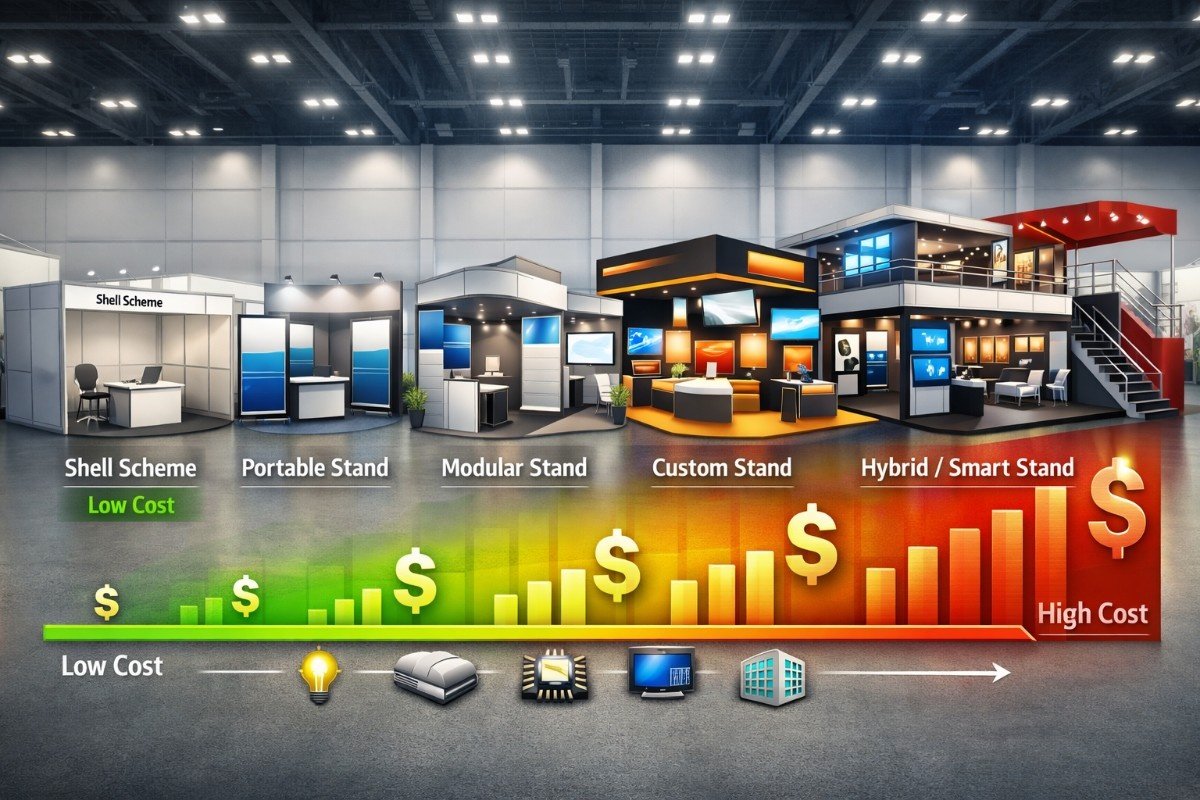
Understanding the cost of exhibition stands is essential for effective budgeting and strategic planning. The price of a stand depends on multiple factors, including the type of stand, size, design complexity, materials, and additional features such as lighting, digital screens, or interactive elements. Knowing these costs in advance helps businesses make informed decisions that balance investment with expected return on exhibition performance.
Shell Scheme Stands
Overview:
Shell scheme stands are the most basic and cost-effective option, often provided by event organizers with minimal customization.
Cost Range:
- Typically low, making them suitable for businesses with tight budgets
- Small booths may start at a few hundred dollars/equivalent
- Larger setups may cost slightly more depending on additional graphics or furniture
Factors Affecting Cost:
- Added branding or printed panels
- Extra lighting or display units
- Electrical requirements
Best For: First-time exhibitors, small businesses, or one-off events
Modular Exhibition Stands
Overview:
Modular stands offer flexibility and reusability, making them ideal for businesses participating in multiple exhibitions.
Cost Range:
- Medium, depending on size and component quality
- Small modular setups: moderate investment
- Larger, highly customizable modular stands: higher cost but reusable
Factors Affecting Cost:
- Number of components used
- Level of customization
- Storage and transportation requirements
Best For: Businesses with frequent exhibitions seeking cost efficiency and consistent branding
Custom Exhibition Stands
Overview:
Custom stands are fully bespoke and designed to meet specific branding and functional requirements, delivering maximum visual impact.
Cost Range:
- High, as they require unique design, fabrication, and installation
- Price depends on materials, size, and technology integration
Factors Affecting Cost:
- Custom-built structures and materials
- Advanced lighting, technology, or interactive elements
- Structural complexity and multi-level designs
Best For: High-profile exhibitions, product launches, and premium brand positioning
Portable Exhibition Stands
Overview:
Portable stands are lightweight, easy to transport, and convenient for businesses with frequent travel needs.
Cost Range:
- Low to medium
- Costs vary depending on size, design, and quality of materials
Factors Affecting Cost:
- Number of display panels or banners
- Ease of assembly
- Additional features like storage compartments or digital integration
Best For: Startups, small businesses, and companies needing quick, repeatable setups
Double Decker Exhibition Stands
Overview:
Double decker stands maximize vertical space and offer premium visual impact, ideal for larger businesses at high-traffic events.
Cost Range:
- High, due to design, fabrication, and structural requirements
- Often among the most expensive options for trade show participation
Factors Affecting Cost:
- Two-level structural design
- Safety compliance and approvals
- Premium materials and finishes
Best For: Large enterprises, flagship events, and exhibitions requiring private meeting areas
Hybrid or Smart Exhibition Stands
Overview:
Hybrid stands integrate digital technology with physical structures to create immersive and interactive experiences.
Cost Range:
- Medium to high, depending on technology and custom features
- Costs increase with the inclusion of interactive screens, VR/AR elements, or data capture systems
Factors Affecting Cost:
- Type and quantity of technology
- Level of integration with physical design
- Maintenance and setup support
Best For: Tech-focused brands, experiential marketing campaigns, and interactive exhibitions
Exhibition Stand Solutions Across Different Markets
When planning for exhibitions, businesses must consider the diversity of markets in which they operate. Exhibition stand requirements can vary significantly depending on regional trade show norms, audience expectations, and the scale of the event. Selecting a stand that aligns with these factors ensures maximum impact and consistent brand presence across different markets.
Adapting Stands for Local Markets
Even without focusing on a specific country, businesses should design stands that resonate with local audiences and exhibition conditions:
- Regional Trade Shows: Smaller, focused exhibitions often favor portable or modular stands that are quick to set up and adaptable to limited spaces.
- High-Traffic Events: Larger exhibitions with significant footfall benefit from custom or hybrid stands to create visual impact and capture visitor attention.
- Local Business Networks: Businesses participating in local market events may prioritize cost-efficient solutions, such as shell scheme stands, to maintain presence without overextending resources.
By tailoring stand types and layouts to the scale and style of each event, companies can engage visitors effectively while maintaining brand consistency.
Consistency Across Global Exhibitions
For businesses participating in exhibitions across different regions, maintaining a consistent brand image is critical:
- Modular and hybrid stands allow for reconfiguration while preserving core branding elements such as logos, colors, and messaging.
- Custom stands can be adapted for flagship events in multiple locations by maintaining design themes, ensuring a recognizable brand presence.
- Portable stands offer convenience for smaller exhibitions while still reflecting the brand identity.
Consistency across exhibitions enhances brand recall, reinforces credibility, and ensures that audiences associate the same visual identity with the business regardless of the market.
Considerations for International Market Participation
Businesses that operate in international or cross-regional trade shows must also factor in practical considerations:
- Transport and Logistics: Modular and portable stands reduce shipping complexity and assembly time.
- Adaptable Layouts: Flexible designs allow for variations in booth sizes and exhibition hall layouts.
- Audience Engagement: Different markets may have varying expectations for interaction, which can be addressed by including technology-driven or experiential elements in hybrid stands.
Even without specifying particular countries, designing with these factors in mind ensures that businesses are prepared for any regional or international exhibition environment.
Latest Trends in Exhibition Stand Design
Exhibition stand design is evolving rapidly as businesses seek to create memorable experiences and stay ahead of the competition. Modern stands are no longer just display spaces; they are strategic tools that combine creativity, technology, and sustainability to attract, engage, and retain visitors. Understanding these trends helps businesses design stands that are not only visually appealing but also effective in achieving marketing goals.
1. Sustainable and Eco-Friendly Stands
Sustainability is becoming a key consideration in exhibition design:
- Use of Recyclable Materials: Lightweight, reusable, and eco-friendly materials are replacing traditional construction methods.
- Energy-Efficient Lighting: LED lighting and solar-powered setups reduce energy consumption.
- Minimal Waste Design: Modular and portable stands help minimize waste and reduce the environmental footprint of exhibitions.
Adopting eco-friendly solutions positions your business as socially responsible while also reducing long-term costs through reusability.
2. Technology-Driven Stands
Technology is transforming how visitors interact with exhibition booths:
- Digital Displays and Screens: Video walls, touchscreens, and dynamic graphics capture attention and convey information efficiently.
- Interactive Experiences: Virtual reality (VR), augmented reality (AR), and gamified elements increase engagement and provide memorable brand experiences.
- Data Capture and Analytics: Integrated tools track visitor interactions and provide insights for post-event follow-up.
These innovations make stands more engaging and provide measurable results, helping businesses refine their exhibition strategies.
3. Experiential Marketing Setups
Experiential marketing focuses on creating immersive experiences that leave a lasting impression:
- Themed Booths: Custom environments that align with brand storytelling.
- Hands-On Demonstrations: Product trials and interactive displays encourage visitor participation.
- Social Sharing Opportunities: Design elements that encourage visitors to capture and share their experience online, amplifying brand reach.
Experiential stands make a booth more than a display; it becomes a destination within the exhibition.
4. Minimalist and Flexible Designs
Modern exhibition stands increasingly favor simplicity and flexibility:
- Open Layouts: Encourage free movement and better interaction with visitors.
- Modular Components: Allow easy reconfiguration for different booth sizes and events.
- Clean Branding: Focused messaging and uncluttered visuals enhance professional appeal.
Minimalist designs reduce setup time, improve visitor flow, and allow the brand message to stand out clearly.
5. Multi-Sensory Engagement
Leading brands are incorporating sensory experiences to create stronger impressions:
- Audio and Visual Effects: Background music, soundscapes, and dynamic lighting enhance the environment.
- Touch and Interaction: Tactile product displays and interactive kiosks engage multiple senses.
- Scent and Ambiance: Subtle use of scents or thematic elements reinforces the brand experience.
Engaging multiple senses increases the likelihood of visitor retention and meaningful interactions.
Conclusion
Choosing the right exhibition stand is a strategic decision that directly impacts your brand visibility, engagement, and return on investment. From shell schemes and portable stands to modular, custom, double-decker, and hybrid solutions, each type offers unique advantages depending on your objectives, budget, and exhibition strategy. A successful exhibition stand combines functionality, visual appeal, and strategic alignment with business goals. Businesses that carefully evaluate their audience, exhibition frequency, and regional considerations can select stands that maximize engagement and deliver measurable results. Incorporating modern trends such as sustainable materials, technology-driven elements, and experiential setups further enhances the effectiveness of your presence. By understanding the different stand types and making informed decisions, your business can create memorable experiences, strengthen brand perception, and generate meaningful leads across multiple markets.
FAQs
1. What are the types of exhibition stands?
Exhibition stands include shell scheme, modular, custom, portable, double-decker, and hybrid stands. Each type varies in design, flexibility, cost, and branding potential, catering to different business objectives and exhibition requirements.
2. Which exhibition stand is best for small businesses?
Small businesses often benefit from shell schemes or portable stands. These options are cost-effective, easy to transport, and provide a professional presence without a large investment.
3. What is a modular exhibition stand?
A modular exhibition stand is a flexible setup made from reusable components. It can be reconfigured for different booth sizes and exhibitions, offering a balance between cost efficiency and visual appeal.
4. How much does an exhibition stand cost?
Costs vary depending on stand type, size, materials, and features. Shell schemes and portable stands are generally low-cost, modular stands are mid-range, and custom or double-decker stands are higher-end investments.
5. What is the difference between modular and custom exhibition stands?
Modular stands use pre-engineered components and are reusable, flexible, and moderately customizable. Custom stands are fully bespoke, offering maximum design freedom and visual impact but are usually more expensive and less reusable.
6. Are portable exhibition stands effective?
Yes, portable stands are effective for businesses seeking convenience, quick setup, and cost efficiency. While they may offer limited customization, they are ideal for small businesses or frequent exhibitors.
7. How can I make my exhibition stand more engaging?
Incorporate interactive elements, digital displays, product demonstrations, and experiential features. Engaging multiple senses, sight, touch, sound enhances visitor experience and increases brand recall.
8. How do exhibition stands differ across markets?
Different markets and exhibition scales influence stand choice. Smaller local events may favor portable or shell scheme stands, while high-traffic or international exhibitions benefit from modular, custom, or hybrid stands to maximize impact and engagement.